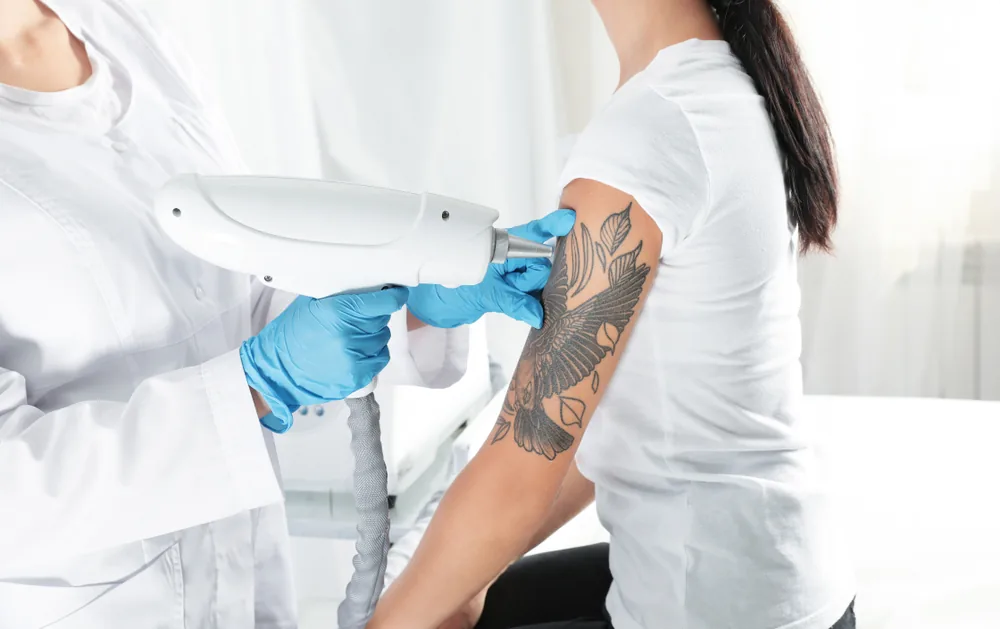
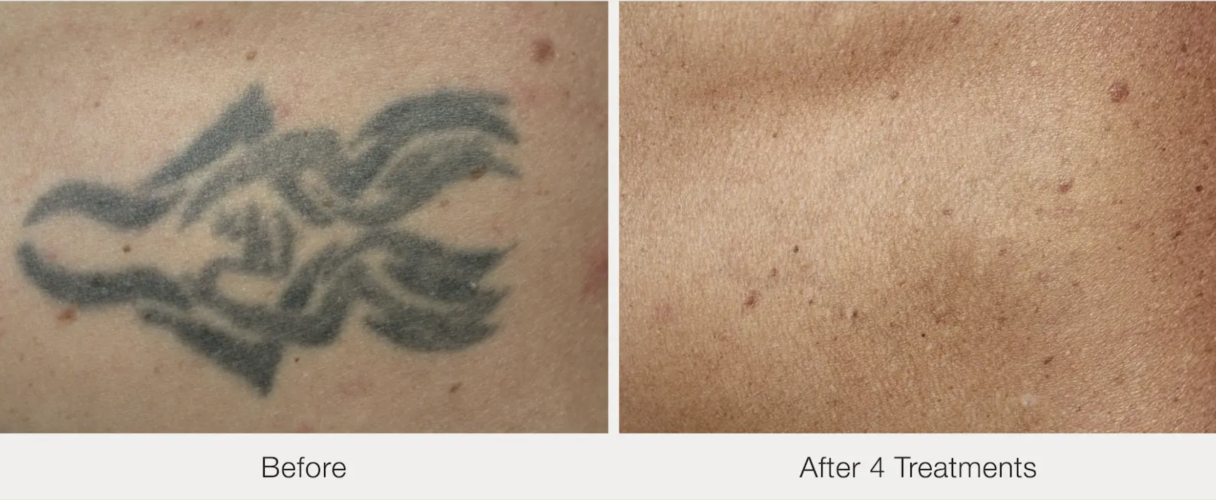
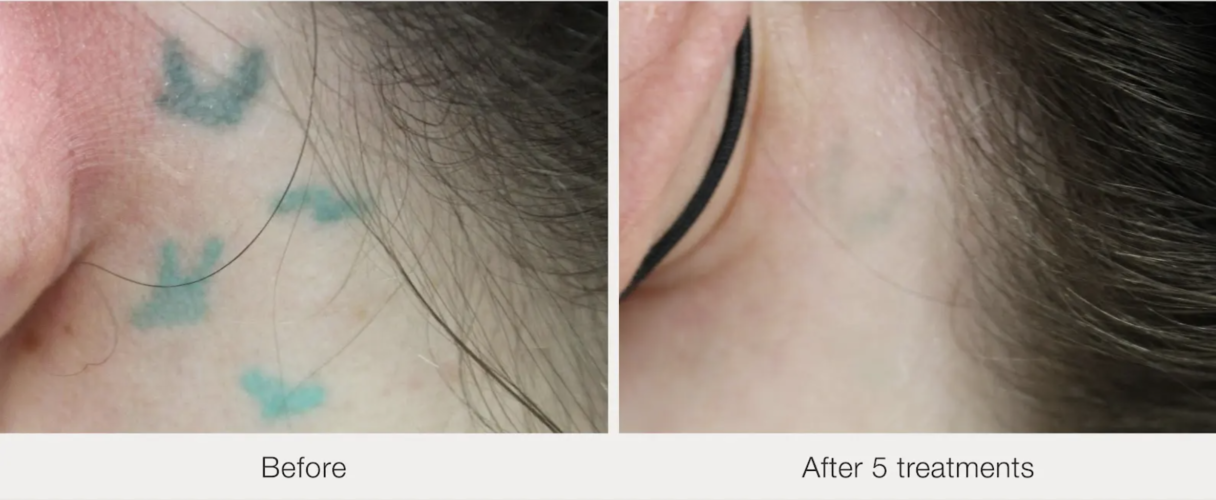
Laser tattoo removal uses precisely targeted light to shatter tattoo ink into particles your immune system clears over time. With a modern picosecond laser like PicoWay, most tattoos fade substantially over 8–12 sessions spaced 6–8 weeks apart. Results depend on ink color, tattoo age, depth, and skin tone, and treatment is safest when supervised by a physician.
What is laser tattoo removal?
Laser tattoo removal is a non-surgical procedure that uses short, high-intensity pulses of light to break tattoo ink into fragments small enough for your body to absorb and clear. Tattoo ink sits in the dermis, the deeper layer of skin, where the particles are too large for your immune system to remove on its own — which is exactly why tattoos are permanent. A laser changes that equation by shattering those particles into pieces your body can finally carry away.
The light is delivered at specific wavelengths that are absorbed by the ink but largely pass over the surrounding skin. Over a series of sessions, the fragmented ink is gradually flushed out through your lymphatic system, and the tattoo fades progressively lighter. Modern picosecond lasers have made this process faster and gentler than the older technology many people still picture, but removal is still a series of treatments over months — not a single erasing session.
At Laser Eraser, every treatment is performed by a licensed medical provider and delivered with the PicoWay picosecond laser, tuned to your skin type and the specific ink colors in your tattoo.
How PicoWay technology works — the science
PicoWay is a picosecond laser, meaning it fires in trillionths of a second. That ultra-short pulse duration is the key to how it works. When energy is delivered that quickly, it produces a photoacoustic effect — a rapid pressure wave that mechanically shatters ink particles — rather than relying mainly on heat. Because less heat spreads into the surrounding tissue, there is less risk to the skin around the ink and a smaller window for unwanted side effects.
The result of that photoacoustic shattering is that ink is broken into much finer particles than older lasers produced. Smaller fragments are easier for your immune system to recognize and clear, which is why picosecond technology can often achieve better fading in fewer sessions than the millisecond and nanosecond lasers that came before it.
Different ink colors absorb different wavelengths of light, so no single beam removes every color equally. PicoWay's dual-wavelength flexibility (a 532nm and a 1064nm wavelength) lets a physician match the laser to the pigment being treated — the 1064nm wavelength is well suited to dark inks like black and blue, while the 532nm wavelength targets warmer colors such as red. Matching wavelength to ink, and adjusting settings for your skin, is precisely the kind of judgment that benefits from physician oversight.
- Picosecond pulses (trillionths of a second) shatter ink through pressure, not just heat
- Finer ink fragments are cleared more efficiently by your immune system
- Dual wavelengths (532nm + 1064nm) let a physician match the laser to each ink color
- Lower heat transfer means a smaller margin for damage to surrounding skin
Who is a good candidate for laser tattoo removal?
Most healthy adults who want a tattoo lightened or removed are candidates for laser tattoo removal — but the best plan depends on your skin tone, the ink involved, and your overall health. A consultation exists to sort this out honestly rather than promise the same result to everyone.
Skin tone matters because both ink and the melanin in your skin can absorb laser energy. Historically, darker skin tones carried a higher risk of pigment changes. Picosecond lasers have improved this considerably: PicoWay's ultra-short pulses limit heat transfer to surrounding melanin, which makes safe treatment achievable across a wide range of skin tones (Fitzpatrick I–VI) when settings are customized for the individual. This customization is where physician supervision is most valuable.
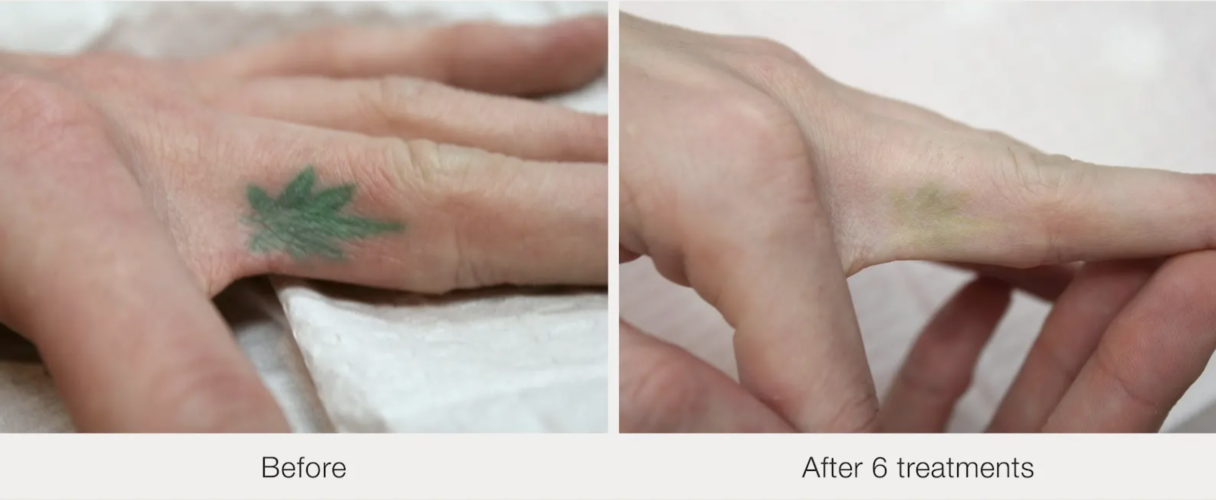
Ink color and age also shape what is realistic. Black and dark inks respond best; some colors — particularly greens, light blues, and yellows — are more stubborn and may fade rather than disappear completely. Older, faded tattoos generally clear sooner than fresh, densely saturated ones. Certain factors call for caution or a delay, including pregnancy, active infection or irritation over the tattoo, a recent tan or sunburn on the area, and some medications or skin conditions — all reasons a physician screens you before treatment begins.
- Best candidates: healthy adults with fully healed tattoos and realistic expectations
- All skin tones (Fitzpatrick I–VI) can be treated when settings are individualized
- Black and dark inks fade fastest; greens, light blues, and yellows are more resistant
- Screened for caution: pregnancy, active infection, recent tan or sunburn, certain medications
What to expect: step-by-step treatment timeline
Laser tattoo removal follows a predictable arc: a consultation, a series of quick sessions spaced weeks apart, a short healing window after each visit, and gradual fading in between. Understanding the rhythm up front makes the whole process feel far less daunting.
It starts with a free consultation, where a physician examines the tattoo, assesses your skin type, ink colors, age, and placement, and maps out an honest plan — including how many sessions to expect and your flat-rate package price. Each treatment session itself is short, often around 10 minutes or less for a small piece, and you can typically return to normal activities the same day with proper aftercare.
Between sessions, your body does the real work: the fragmented ink is gradually cleared, and the tattoo looks progressively lighter. Sessions are spaced roughly 6–8 weeks apart to give your skin time to heal and your immune system time to remove the ink from the previous treatment. Because clearing happens over weeks, full removal is a months-long commitment rather than a quick fix.
| Stage | What happens | Typical timing |
|---|---|---|
| Free consultation | Physician assesses ink, skin type, and placement; sets your plan and flat-rate package | Day 0 |
| Treatment session | PicoWay laser passes over the tattoo; procedure is quick, often ~10 minutes | Each visit |
| Immediate healing | Redness, mild swelling, possible frosting or blistering; cared for with aftercare | First 1–2 weeks |
| Fading between visits | Immune system clears fragmented ink; tattoo looks progressively lighter | 6–8 weeks between sessions |
| Complete course | 8–12 sessions on average for full removal, varying by tattoo | Several months to ~2 years |
How many sessions will I need?
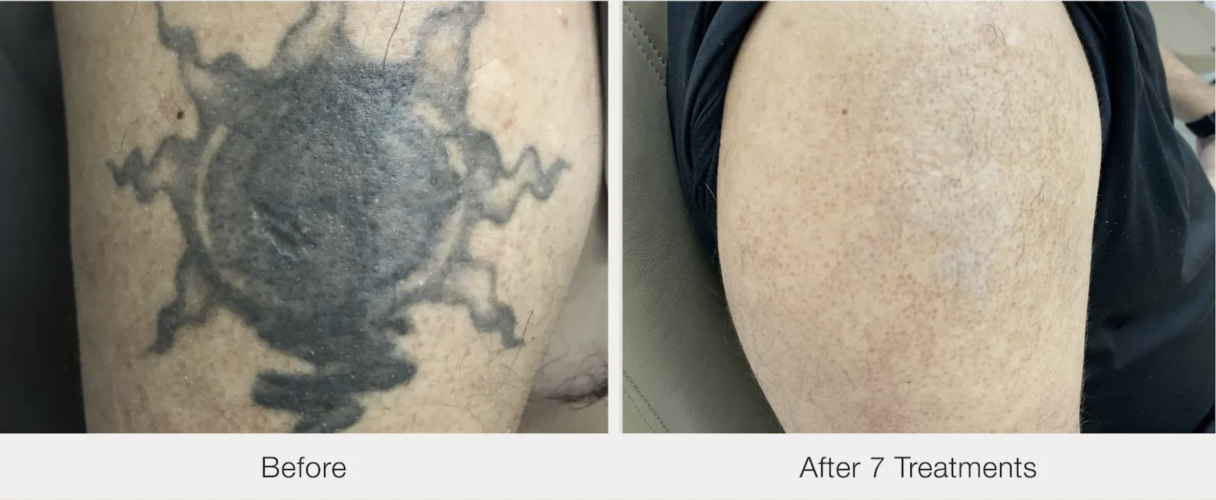
Most tattoos take 8–12 sessions to fully remove with the PicoWay laser, though simple black tattoos may need fewer and large, multi-color pieces may need more. There is no single number that fits every tattoo, which is why a physician estimates your range in person rather than from a photo.
Clinicians often use the Kirby-Desai scale to estimate session counts before starting. It assigns points across several factors — skin type, tattoo location, ink color, the amount of ink, any layering or scarring, and whether the tattoo is amateur or professional — and adds them up to predict how many sessions removal is likely to take. It is a guide, not a guarantee, but it helps set honest expectations from day one.
The variables below explain why two tattoos of the same size can need very different numbers of sessions. Whatever the count, at Laser Eraser every session your tattoo needs is already covered by a single flat-rate package price — so more sessions never means a higher bill.
| Factor | Faster removal | Slower removal |
|---|---|---|
| Ink color | Black, dark blue | Green, light blue, yellow |
| Tattoo age | Older, faded ink | Fresh, saturated ink |
| Ink density | Fine-line, sparse work | Dense, packed, layered work |
| Placement | Upper arm, torso (good circulation) | Hands, feet, ankles (slower clearing) |
| Origin | Amateur tattoos (less ink) | Professional tattoos (more, deeper ink) |
Does laser tattoo removal hurt?
Most people describe laser tattoo removal as feeling like a rubber band snapping against the skin — uncomfortable but tolerable, and over quickly. Because sessions are short, the sensation is brief, and many patients tell us it was less painful than they feared, and often less than getting the tattoo in the first place.
Pain varies by location. Areas with thin skin and more nerve endings — ribs, hands, feet, and ankles — tend to be more sensitive, while fleshier areas like the outer arm and thigh are usually more comfortable. Your tolerance and the size of the piece also shape the experience.
Comfort options make a real difference. A topical numbing cream applied before treatment can significantly reduce discomfort, and cooling the skin during and after the session helps as well. Because Laser Eraser is physician-led, comfort and any reactions are managed by a medical provider rather than left to a technician — one more reason patients often report a gentler experience than they expected.
How much does laser tattoo removal cost in NJ?
At Laser Eraser, tattoo removal is priced as a single flat-rate Complete Removal Package based on the size of the tattoo — one price that covers every session you need, rather than charging you per visit. Because the number of sessions is already included, you know your total commitment before you begin, and patients typically save around 38% versus paying session by session.
Packages are financeable through our Buy-Now-Pay-Later partner, with no hidden fees, so the figures below are the monthly amounts a tattoo of each size can start from. Multiple tattoos or a partial removal can be scoped and quoted at your free consultation.
One honest note: cosmetic tattoo removal is not covered by insurance. That is precisely why we build transparent, financeable flat-rate packages and offer a complimentary consultation to price your specific tattoo before you commit to anything.
| Package | Tattoo size | From |
|---|---|---|
| Extra Small | up to 1 sq in | a custom quote |
| Small | up to 4 sq in | a custom quote |
| Medium | up to 9 sq in | a custom quote |
| Large | up to 16 sq in | a custom quote |
| Extra Large | up to 25 sq in | a custom quote |
| XXL | 25–88 sq in | a custom quote |
Aftercare: what to do between sessions
Good aftercare protects your results and lowers the risk of complications. Right after a session, the treated area is essentially a superficial wound — it may be red, swollen, and tender, and can develop temporary frosting, blistering, or scabbing as it heals. Treating it gently is what keeps healing on track.
The core principles are simple: keep the area clean and protected, resist the urge to pick or scratch scabs and blisters, and shield the skin from the sun. Sun protection is the single most important step between sessions — a fresh tan or burn over a treated tattoo can raise the risk of pigment changes and may mean delaying your next visit. You will receive specific instructions after each session, and because your care is physician-directed, you have medical guidance if anything looks unusual.
- Keep the area clean, dry, and lightly protected as directed after each session
- Do not pick, scratch, or pop blisters or scabs — let them heal on their own
- Protect the treated skin from the sun; avoid tanning between sessions
- Avoid soaking (pools, hot tubs, long baths) until the skin has healed
- Follow your physician's specific aftercare instructions and reach out with any concerns
Risks, side effects, and what's normal
Laser tattoo removal is considered very safe when performed correctly, and most side effects are mild and temporary. In the days after a session it is completely normal to see redness, swelling, tenderness, frosting (a temporary whitening of the treated area), and sometimes blistering or scabbing. These are signs of the skin healing, not of something going wrong, and they resolve on their own with proper aftercare.
When performed correctly by a trained physician, laser tattoo removal does not typically cause scarring, because the laser targets ink particles rather than the surrounding tissue. The less common risks worth knowing about include temporary or, rarely, longer-lasting pigment changes (skin becoming lighter or darker in the treated area), infection if aftercare is neglected, and scarring — risks that rise with improper technique, incorrect settings for your skin type, or treating a sun-damaged area. This is the core reason to choose a physician-led provider: correct settings, careful screening, and immediate management if a reaction occurs.
There is no credible evidence that laser tattoo removal causes cancer. It is also important to set honest expectations: while many tattoos can be fully removed, some — depending on ink colors and depth — may fade significantly rather than disappear completely, which a physician will discuss with you candidly before you start.
- Normal and temporary: redness, swelling, frosting, blistering, scabbing
- Less common: temporary pigment changes, infection (with poor aftercare), scarring
- Correct technique and physician-set settings minimize the risk of scarring
- No credible evidence links laser tattoo removal to cancer
- Some tattoos fully clear; others fade substantially — expectations set honestly up front
Why physician-led removal matters
The people performing your tattoo removal matter as much as the laser itself. Laser Eraser is physician-owned and physician-operated — every treatment is administered by a licensed medical provider, not a technician or spa staff. Founder Dr. Alvaro Alban is an emergency-medicine physician in New Jersey who pursued specialized training at the Institute for Laser Medicine in Skippack, Pennsylvania, with a focus on laser tattoo removal including large and multi-color work, full back pieces, and arm and leg sleeves.
A physician can screen for contraindications, customize the laser settings to your exact skin type and ink, recognize and manage a reaction on the spot, and set honest expectations rather than overpromising. That combination of PicoWay technology, transparent flat-rate packages, two New Jersey locations in Clark and Paramus, and free consultations is what distinguishes a doctor-led clinic from a franchise or med-spa model.
Complete Removal Packages by Size
8–12 sessions · every session includedOne flat price covers all the sessions your tattoo needs — no per-visit billing. Every tattoo is priced individually, so we give you an exact quote free at your consultation.
Every tattoo is priced individually. Book a free consultation for your exact quote — no obligation.
Get Your Free QuoteFrequently asked questions
Most tattoos need 8–12 sessions with the PicoWay laser, spaced 6–8 weeks apart. Black and dark ink usually clears fastest, while multi-color pieces take longer. Tattoo age, ink density, depth, placement, and skin tone all affect the count. At Laser Eraser, every session is covered by one flat-rate package, so more sessions never costs more.
Most patients describe it as a rubber band snapping against the skin — uncomfortable but tolerable, and quick, since sessions are short. A topical numbing cream applied before treatment and skin cooling during it reduce discomfort significantly. Sensitive areas like ribs, hands, and feet hurt more than fleshier spots like the outer arm and thigh.
When performed correctly by a trained physician, laser tattoo removal does not typically cause scarring, because the laser targets ink rather than surrounding skin. Scarring risk rises with improper technique, wrong settings for your skin type, treating sun-damaged skin, or picking at healing blisters. Physician-led treatment and good aftercare keep that risk very low.
Many tattoos can be fully removed, but not every one is guaranteed to disappear completely. Black and dark inks respond best, while some colors — like green, light blue, and yellow — may fade substantially rather than vanish. Ink depth and density also matter. A physician sets honest expectations for your specific tattoo at your free consultation.
Yes. The PicoWay laser is one of the safer options for darker skin tones (Fitzpatrick IV–VI) because its ultra-short picosecond pulses limit heat transfer to the surrounding melanin, lowering the risk of pigment changes. Safe treatment across skin tones depends on individualized settings, which is exactly what physician-supervised care at Laser Eraser provides.
At Laser Eraser, tattoo removal is a single flat-rate Complete Removal Package based on tattoo size, covering every session needed — tailored to your tattoo for an extra-small tattoo up to a custom quote for an XXL piece, financed and no hidden fees. Packages save about 38% versus per-session pricing. Cosmetic removal isn't covered by insurance; your exact price is set at a free consultation.