
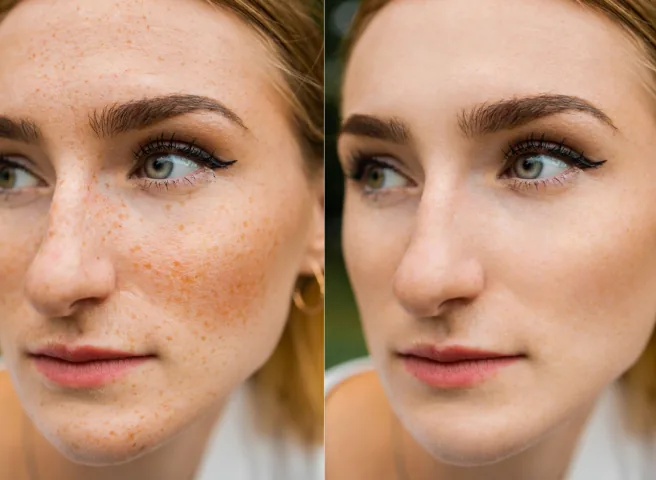
Pigment spot removal at Laser Eraser uses the PicoWay® picosecond laser to break up sun spots, age spots, and other unwanted hyperpigmentation so your body can clear it. Every treatment is clinician-administered at our Clark and Paramus, NJ offices, planned around your skin type, and starts with a free consultation.
What Pigment Spot Removal Treats
"Pigment spots" is an everyday name for the flat brown or tan marks that show up when the skin makes extra melanin in one concentrated area. The most common culprit is the sun: years of daily exposure leave behind sun spots and age spots (also called solar lentigines or liver spots) on the face, backs of the hands, chest, shoulders, and forearms — the places light hits most. They tend to appear gradually with age and sun history, and while they're almost always harmless, many people simply don't like how they read on otherwise even-toned skin.
Beyond classic sun and age spots, the term also covers other forms of surface hyperpigmentation: freckle-like clusters, patches left behind after a blemish or irritation heals, and areas of general uneven tone. Not every dark spot behaves the same way, and conditions like melasma respond very differently to laser energy than a simple sun spot does, which is exactly why a physician evaluates the spot in front of you before recommending anything.
One important note we make with every patient: laser is a cosmetic treatment, not a substitute for a skin check. Any spot that is changing, growing, bleeding, itching, or has irregular borders or color should be examined by a dermatologist first — we're happy to work with you once a concerning lesion has been cleared.
- Sun spots and age spots (solar lentigines / liver spots)
- Freckle-like clusters and uneven surface tone
- Discoloration left behind after breakouts or minor irritation
- Cosmetic pigment concerns on the face, hands, chest, and arms
How PicoWay® Removes Pigment
We treat with the PicoWay® picosecond laser — the same core technology behind our tattoo work — because pigment removal comes down to the same physics. The laser sends energy into the skin in ultra-short picosecond pulses that are absorbed by the dense melanin inside a spot. That rapid burst of energy fractures the pigment into tiny particles without needing to burn or wound the surrounding skin, and your body's own clearance process then carries the fragments away over the following days and weeks.
Because the pulses are so brief and precisely targeted, PicoWay lets a physician concentrate energy on the pigment itself while sparing more of the healthy tissue around it. Settings aren't one-size-fits-all: the laser is customized to your skin type and to the depth and darkness of the spot being treated. A light superficial sun spot on the hand and a deeper, more stubborn patch call for different approaches, and dialing that in is part of what makes physician oversight matter.
Most pigment sessions themselves are quick. Many patients describe the sensation as brief snaps against the skin, and after treatment a spot often looks temporarily darker or forms a fine crust before it flakes away and fades — a normal part of the process we walk you through in advance.
What Treatment Looks Like
Everything starts with a free, no-pressure consultation. A physician examines the spots you want treated — their color, depth, size, and location — and reviews your skin type and sun history so we can build a realistic plan. This is also where we confirm that what you're looking at is a good candidate for cosmetic laser rather than something that belongs with a dermatologist first. You'll leave the consult understanding roughly how many sessions to expect and what results are realistic for your particular pigment.
The number of sessions varies more with pigment than it does with tattoos. Some simple sun spots respond noticeably after just one or two treatments, while deeper or more widespread discoloration takes several sessions spaced a few weeks apart to allow the skin to recover and clear pigment between visits. We're honest that laser can dramatically improve unwanted spots but cannot promise flawless, permanent clearance for every case — and that new spots can form later if the skin sees more sun.
Aftercare is straightforward, and diligent sun protection is the single most important part. Because UV exposure is what created most pigment spots in the first place, daily sunscreen and sun avoidance both protect your results and lower the odds of new spots or post-treatment discoloration. We'll give you clear, simple instructions to follow between appointments.
- Free physician consultation to assess the spots and your skin type
- PicoWay® settings customized to pigment depth and skin tone
- Sessions spaced several weeks apart when more than one is needed
- Simple aftercare with an emphasis on daily sun protection
Safety Across Skin Tones
Pigment treatments demand real care on richer and darker skin tones, and that's a big reason we keep this service physician-led rather than delegating it. Any laser that targets melanin can, if pushed too hard, disturb the normal pigment in surrounding skin — producing either lightened spots (hypopigmentation) or, more commonly, temporary darkening (post-inflammatory hyperpigmentation). Deeper skin tones carry more of this risk, so settings have to be chosen conservatively and thoughtfully for each person.
PicoWay's ultra-short picosecond pulses help here, because delivering energy in such brief bursts allows a clinician to fracture pigment while limiting the heat spread that tends to provoke these reactions. Combined with a physician evaluating your skin type up front and often starting conservatively, this lets us pursue results while respecting your skin's tolerance. When appropriate we may recommend a test area or a more gradual, staged approach rather than aggressive single sessions.
This is also where honest expectation-setting matters most. Conditions like melasma are notoriously easy to worsen with the wrong laser approach, so if your evaluation points to melasma rather than simple sun spots, we'll steer you toward the right strategy instead of promising a quick fix. The goal is always improvement done safely for your specific skin.
Frequently asked questions
Sun spots and age spots are caused mainly by cumulative UV exposure, which prompts the skin to overproduce melanin in concentrated areas. They appear gradually with age and sun history, most often on the face, hands, chest, and forearms. They're usually harmless, but any spot that changes or grows should be checked by a dermatologist first.
It varies more than tattoo removal. Some simple sun spots improve noticeably after one or two PicoWay® treatments, while deeper or more widespread discoloration can take several sessions spaced a few weeks apart. A physician gives you an honest estimate at your free consultation after assessing the spots and your skin type.
It can be, but it requires care. Any melanin-targeting laser carries some risk of temporary lightening or darkening, and that risk is higher on richer skin tones. Because a physician evaluates your skin type and chooses conservative PicoWay® settings — sometimes with a test area — we can pursue results while respecting your skin's tolerance.
Treated spots that clear are generally gone, but pigment spot removal doesn't stop new spots from forming later if your skin sees more sun. That's why daily sunscreen and sun protection are the most important part of aftercare — they safeguard your results and reduce the chance of new discoloration developing over time.
No. Pigment spot removal is a cosmetic treatment, so it generally isn't covered by insurance. Instead of an insurance claim, we offer a free consultation so you understand your plan and pricing up front, along with free, no-obligation quotes to make treatment manageable.