PicoWay is a picosecond laser made by Candela that removes tattoos by firing ultra-short pulses — trillionths of a second — that shatter ink into fine particles your body clears naturally. Its three wavelengths (1064nm, 532nm, 785nm) handle a wider range of ink colors and skin tones than older Q-switched lasers, which is why physician-led clinics like Laser Eraser use it exclusively.
What is PicoWay?
PicoWay is a picosecond laser system manufactured by Candela, a global leader in aesthetic and medical laser devices. "Picosecond" refers to how briefly each laser pulse fires — one picosecond is one trillionth of a second. That extraordinarily short burst is the whole reason the technology exists: it lets the laser break tattoo ink apart mechanically rather than mostly by heat, which is what makes modern removal faster and gentler than the lasers that came before it.
The system is FDA-cleared for tattoo removal, benign pigmented lesions, and certain skin-revision treatments. At Laser Eraser, PicoWay is the only laser we treat with. We don't run a room full of different devices and pick one at the counter — every tattoo, on every skin type, is treated on the same clinician-operated PicoWay platform, with settings customized to your ink colors and skin tone.
How picosecond technology differs from nanosecond Q-switched lasers
For decades, the standard for laser tattoo removal was the Q-switched laser, which fires in nanoseconds — billionths of a second. Picosecond lasers like PicoWay fire roughly a thousand times faster, in trillionths of a second. That speed difference changes how the ink is destroyed.
Q-switched lasers rely heavily on a photothermal effect: they heat ink particles until they fracture, which also transfers more heat into the surrounding skin. PicoWay's much shorter pulse produces a stronger photoacoustic (photomechanical) effect — essentially a rapid pressure wave that shatters pigment into much smaller particles before significant heat can spread to nearby tissue. Smaller particles are easier for your immune and lymphatic systems to carry away, and less collateral heat means a lower risk of skin injury when the device is used correctly.
In practical terms, the shift from nanosecond to picosecond technology is why removal today often takes fewer sessions and tends to be more comfortable than the treatments people remember from years ago — though results still depend heavily on your specific tattoo, your skin, and the skill of whoever is operating the laser.
| Feature | Q-switched (nanosecond) | PicoWay (picosecond) |
|---|---|---|
| Pulse duration | Billionths of a second | Trillionths of a second |
| Primary mechanism | Mostly photothermal (heat) | Stronger photoacoustic (pressure) |
| Ink particle size after treatment | Larger fragments | Finer fragments, easier to clear |
| Heat spread to nearby skin | Higher | Lower |
| Typical performance on tough colors | Limited | Broader color range |
PicoWay's wavelengths — why multiple wavelengths matter for ink color
No single laser wavelength removes every ink color. Different pigments absorb different wavelengths of light, and a wavelength that a color doesn't absorb simply passes through it without effect. This is the single biggest reason older or single-wavelength devices struggle with multi-color tattoos — and it's where PicoWay's design stands out.
PicoWay offers three wavelengths: 1064nm, 532nm, and 785nm. Having all three on one platform means the physician can match the light to the pigment rather than forcing every color through one setting. Black and dark blue inks respond well to the 1064nm wavelength; warm colors like red, orange, and some yellows respond to 532nm; and the 785nm wavelength targets stubborn blues and greens that have historically been the hardest colors to clear.
For a multi-color tattoo, that flexibility matters enormously. Instead of clearing the black quickly and leaving a ghost of green or blue behind, PicoWay lets a physician treat each color band with the wavelength best suited to it — the practical advantage of using a modern picosecond system for anything beyond a simple black tattoo.
| Wavelength | Best suited for these ink colors |
|---|---|
| 1064nm | Black, dark blue, and dark inks |
| 532nm | Red, orange, warm yellows, some browns |
| 785nm | Stubborn blues and greens |
Clinical evidence and FDA clearance
PicoWay is FDA-cleared for the removal of tattoos and benign pigmented lesions, and picosecond laser technology has been studied in peer-reviewed dermatology and laser-medicine literature for tattoo clearance across a range of ink colors and skin types. Picosecond devices are now widely regarded within aesthetic medicine as a leading approach for tattoo removal.
We share this evidence honestly. Published research and FDA clearance establish that the technology works and is safe when used appropriately — but no laser, including PicoWay, can guarantee complete removal of every tattoo. Outcomes vary with ink type and depth, tattoo age, your skin tone, and how efficiently your body clears fragmented pigment. That is exactly why we set expectations individually at a consultation rather than promising a fixed result to everyone.
PicoWay for skin of color — safety considerations
One of the most common — and most important — questions we hear is whether laser tattoo removal is safe for darker skin tones. With PicoWay, the answer is that it is one of the better-suited options for Fitzpatrick IV–VI skin, because its ultra-short pulse duration limits heat transfer to the melanin in surrounding skin. Excess heat is what historically raised the risk of hyperpigmentation (darkening) or hypopigmentation (lightening) in patients with more melanin, so minimizing it is central to treating skin of color safely.
Technology alone isn't the whole answer, though — technique is. Darker skin requires more conservative settings, careful wavelength selection (the 1064nm wavelength is generally favored for deeper skin tones), and an experienced eye to read how the skin responds between sessions. This is a major reason we treat every patient under physician supervision rather than a fixed one-size protocol. Safe, effective removal on skin of color is very achievable; it just demands a customized plan.
- PicoWay's short pulse limits heat spread to surrounding melanin
- The 1064nm wavelength is generally preferred for deeper skin tones
- Conservative, individualized settings reduce pigment-change risk
- Physician oversight adjusts the plan based on how your skin responds
PicoWay vs. PicoSure — head-to-head
PicoWay and PicoSure are both picosecond lasers, and both are strong, modern tattoo-removal systems — this is not a question of one being outdated. The meaningful difference comes down to wavelengths. PicoWay is built around three wavelengths (1064nm, 532nm, 785nm), while PicoSure is centered on a 755nm wavelength (with an add-on 532nm option).
That gives PicoWay broader native flexibility across ink colors on a single platform, which is particularly useful for multi-color tattoos and for the darker-skin-tone safety profile the 1064nm wavelength supports. PicoSure's 755nm is excellent for certain blues and greens and for some skin-revision applications. For general-purpose, multi-color tattoo removal across a wide range of skin types, PicoWay's wavelength range is the reason many physician-led clinics — including Laser Eraser — standardize on it.
The most honest takeaway: both are capable picosecond lasers, and in skilled hands either can deliver excellent results. The bigger variable is almost always the operator, not the badge on the machine.
| Factor | PicoWay | PicoSure |
|---|---|---|
| Laser type | Picosecond | Picosecond |
| Core wavelengths | 1064nm, 532nm, 785nm | 755nm (532nm optional) |
| Multi-color versatility | Broad, three wavelengths on one platform | Strong on certain blues/greens |
| Darker skin tones | 1064nm well-suited for Fitzpatrick IV–VI | Capable with careful settings |
| Bottom line | Wide-range, all-purpose color coverage | Excellent for specific colors and skin revision |
What a PicoWay session feels like at Laser Eraser
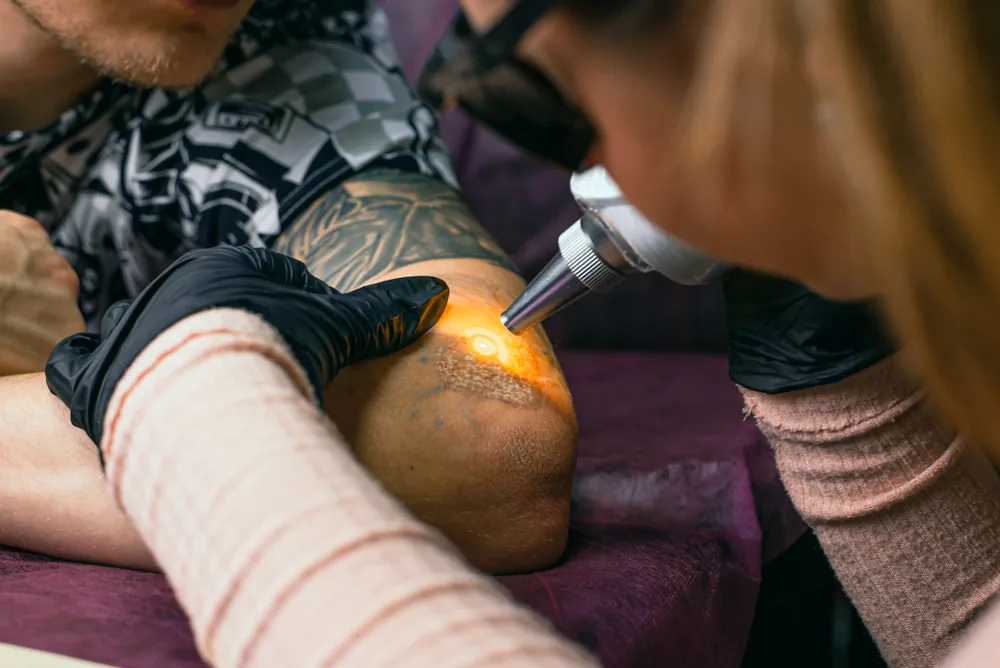
Most patients describe the sensation as a rubber band snapping against the skin — noticeable but tolerable, and typically over quickly. Sessions are short; many tattoos are treated in roughly ten minutes or less, which is one of the practical advantages of a fast picosecond system. A topical numbing cream can be applied beforehand to reduce discomfort, and sensitivity varies by location — ribs, hands, and feet tend to be more tender than arms and thighs.
During treatment you'll often see the tattoo turn a temporary frosty white — a normal, immediate reaction as the laser interacts with the ink. Afterward, mild redness or swelling is common and settles over the following days; we send you home with clear aftercare instructions. Sessions are spaced several weeks apart so your body has time to clear the fragmented pigment between visits, which is why complete removal is a series of appointments rather than a single one.
What's different here is who is holding the laser. Every treatment at Laser Eraser is performed by a licensed medical provider. Founder Dr. Alvaro Alban is an emergency-medicine physician who pursued specialized training at the Institute for Laser Medicine in Skippack, Pennsylvania, with a focus on laser tattoo removal — including large and multi-color pieces such as full back pieces and arm and leg sleeves. A physician can assess contraindications, tailor wavelength and energy settings to your exact skin type and ink, and manage the treatment plan session to session — a genuine difference from a technician-run or spa model.
How PicoWay fits our pricing and process
Because the PicoWay laser is used across every tattoo we treat, we can price removal simply and transparently. Rather than billing per session, we set a single flat-rate Complete Removal Package that covers all the sessions your tattoo needs — typically 8–12 — based on its size. Packages are priced individually with financing through our Buy-Now-Pay-Later partner, and patients typically save around 38% versus paying session by session.
The exact package and a realistic session estimate are set at a free consultation at our Clark or Paramus, NJ location, where a physician evaluates your tattoo's colors, density, age, and placement alongside your skin type. Cosmetic tattoo removal isn't covered by insurance, which is precisely why we build transparent, financeable flat-rate packages instead.
Frequently asked questions
PicoWay is FDA-cleared for tattoo removal and benign pigmented lesions. It is a picosecond laser manufactured by Candela and is widely used in physician-led aesthetic and dermatology practices. FDA clearance confirms the device is safe and effective for tattoo removal when used appropriately, though no laser can guarantee complete removal of every tattoo.
Most tattoos take 8–12 sessions with the PicoWay laser, spaced several weeks apart. Black and dark blue inks often clear faster; multi-color tattoos usually need more sessions. Tattoo age, ink density, depth, skin tone, and how quickly your body clears pigment all affect the total. A free consultation gives you a personalized estimate.
Both are modern picosecond lasers. PicoWay offers three wavelengths (1064nm, 532nm, 785nm) versus PicoSure's core 755nm, giving PicoWay broader native flexibility for multi-color tattoos and a strong safety profile on darker skin. Both deliver excellent results in skilled hands — the operator matters more than the machine.
Different ink colors absorb different wavelengths of light, and a wavelength a pigment doesn't absorb has no effect on it. PicoWay's three wavelengths let a physician match the laser to each color — 1064nm for black and dark inks, 532nm for warm reds and yellows, and 785nm for stubborn blues and greens — so multi-color tattoos clear more evenly.
Yes. PicoWay is one of the better-suited lasers for Fitzpatrick IV–VI skin because its ultra-short pulse limits heat transfer to surrounding melanin, lowering the risk of pigment change. The 1064nm wavelength is generally preferred for deeper skin tones. Safe results depend on conservative, customized settings — which is why we treat every patient under physician supervision.
Most patients describe PicoWay as feeling like a rubber band snapping against the skin — uncomfortable but tolerable, and typically over in about ten minutes or less. A topical numbing cream applied beforehand reduces discomfort. Sensitivity varies by location; ribs, hands, and feet tend to be more tender than arms and thighs.