PicoWay is a picosecond laser that shatters ink with ultra-fast pulses, while a Q-switched laser is an older nanosecond device that relies more on heat. For most tattoos, PicoWay tends to clear ink in fewer sessions, with less thermal risk to skin and stronger results on stubborn colors. Both are FDA-cleared and effective. At Laser Eraser in NJ, every PicoWay treatment is physician-led.
The Quick Verdict
If you want the short answer: PicoWay, a picosecond laser, generally has the edge over a traditional Q-switched (nanosecond) laser because its far shorter pulses shatter ink mechanically rather than mainly heating it, which usually means fewer sessions, a gentler experience for surrounding skin, and better performance on tough colors. That said, a Q-switched laser is still a proven, FDA-cleared tool that clears many tattoos well, especially straightforward black ink. Both work; the question is how efficiently and how comfortably.
Laser Eraser is built entirely around the PicoWay picosecond platform, and every treatment is administered by a licensed medical provider rather than a spa technician. Below we lay out the real differences side by side, give the alternative a fair hearing, and explain where PicoWay's advantage is genuine rather than marketing.
Picosecond vs Nanosecond: How Each Laser Works
The names describe the two devices honestly. A Q-switched laser fires in nanoseconds, billionths of a second. PicoWay fires in picoseconds, trillionths of a second, roughly a thousand times shorter. That difference in pulse duration changes the physics of how ink is broken apart, and it is the single most important reason the two lasers perform differently.
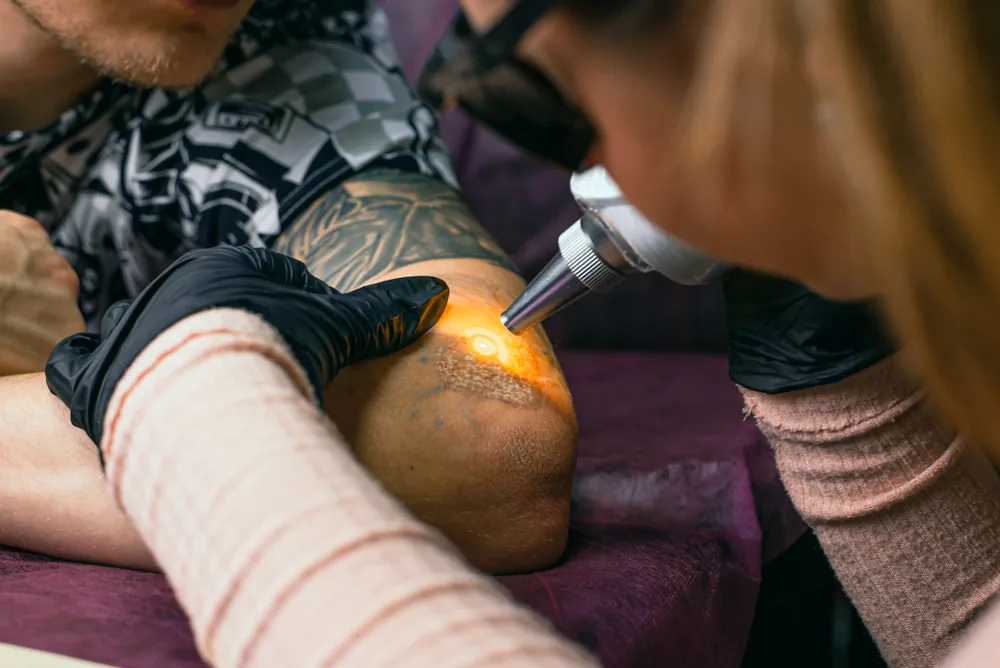
When a nanosecond Q-switched pulse hits pigment, a large share of the energy converts to heat. That heat helps fracture the ink, but it also spreads into the surrounding skin and tends to leave larger ink fragments behind. A picosecond pulse is so brief that it acts more like a rapid mechanical shockwave, a photoacoustic effect that shatters pigment into much finer particles with far less heat. Smaller particles are easier for your body's lymphatic system to carry away, which is why picosecond lasers often make faster visible progress and put less thermal stress on your skin.
Neither laser 'erases' ink on contact. Both fragment the pigment so your immune system can clear it over the weeks between sessions. The picosecond approach simply tends to do that fragmenting more finely and with less collateral heat.
PicoWay vs Q-Switched: Side-by-Side Comparison
Here is how the two technologies stack up across the factors patients ask about most. We have kept the alternative honest; a Q-switched laser is not a bad machine, it is an older generation of the same idea.
| Factor | PicoWay (Picosecond) | Q-Switched (Nanosecond) |
|---|---|---|
| Mechanism | Ultra-short picosecond pulses; shatters ink photoacoustically with minimal heat | Longer nanosecond pulses; relies more on photothermal heat to break ink |
| Sessions | Often fewer visits to clear the same tattoo; complete removal typically 8-12 sessions | Frequently needs more visits for equivalent clearance |
| Pain / comfort | Generally more comfortable; less heat means less stinging for many patients | Effective but often described as more uncomfortable due to greater heat |
| Scarring risk | Lower thermal risk to surrounding skin when properly administered | Higher heat load can raise the risk if settings or technique are off |
| Skin-tone safety | Multiple wavelengths and low heat make it more adaptable across skin types | Usable on darker skin but demands very careful settings; less margin |
| Stubborn colors | Multi-wavelength design targets blues, greens and reds more effectively | Can struggle with resistant blues, greens and bright colors |
| Cost | Flat-rate complete-removal packages tailored to your tattoo; ~38% vs per-session | Varies by provider; often billed per session |
| Availability | Newer, higher-end platform; not offered everywhere | Widely available; the long-standing industry standard |
Where PicoWay's Advantage Is Real, and Where It Isn't
It would be easy to oversell picosecond technology, so here is the honest version. PicoWay's clearest advantages are on colored ink and on skin comfort. Because it delivers multiple wavelengths, it can match the right energy to stubborn pigments like blues and greens that older single-wavelength Q-switched lasers historically struggled with. And because it works with far less heat, many patients find sessions more comfortable and the surrounding skin under less stress, which is meaningful for scarring risk and for darker skin tones.
Where the gap narrows: on simple, older black tattoos that are already fading, a well-run Q-switched laser in experienced hands can still deliver a good result. A picosecond laser is not magic, and no honest provider can guarantee that every tattoo reaches one hundred percent removal with either device. Ink depth, density, color, age, placement, and your own skin and healing all shape the outcome. The laser matters, but the person operating it matters just as much.
That last point is where we would ask you to weigh more than the machine. A great laser run by an undertrained technician is worse than a slightly older laser run by a skilled physician. The technology sets the ceiling; the operator decides how close you get to it.
Why the Operator Matters as Much as the Laser
Laser tattoo removal is a medical procedure. Choosing the correct wavelength for each color, reading how your skin is responding in real time, and adjusting energy safely are clinical judgments, not routine button-presses. At Laser Eraser, that judgment is physician-led. The practice was founded by three physicians — Dr. Alvaro Alban, Dr. Len Hobson, and Dr. Dominic Ruocco. Dr. Alban, an emergency-medicine physician in New Jersey, pursued specialized training at the Institute for Laser Medicine in Skippack, Pennsylvania, and focuses on complex work including full back pieces and arm and leg sleeves.
This is the practical difference between a clinician-administered PicoWay treatment and a walk-in spa or franchise counter. Having a physician directly involved means your skin type, your ink palette, and your safety are managed by someone with medical training, which counts most when settings need to change or when a resistant color needs a different wavelength. Patients frequently tell us the doctors are thorough and knowledgeable, and that the clean, professional setting gave them confidence from the first visit.
So when you compare PicoWay vs Q-switched, remember you are usually also comparing who is holding the handpiece. A premium picosecond laser guided by a physician is a different level of care than the same class of laser run by a technician on a quota.
What This Means for Your Sessions and Cost
Complete removal at Laser Eraser typically takes 8 to 12 PicoWay sessions, spaced weeks apart so your body can clear the shattered pigment between visits. The exact number depends on ink color and density, depth, placement, tattoo age, and your individual skin and healing response. Because PicoWay tends to fragment ink more finely, many tattoos progress efficiently, but we will always give you a realistic estimate rather than a promise.
On price, we remove the guesswork that per-session billing creates. Instead of paying visit by visit, you pay one flat rate that covers all the sessions needed for complete removal, which saves roughly 38 percent compared to paying per session, with no hidden fees. Financing is available through our Buy-Now-Pay-Later partner, with monthly plans starting priced individually for our smallest package size. Larger pieces and multiple tattoos are quoted at your free consultation.
Because cosmetic tattoo removal is generally not covered by insurance, the free consultation is where you get real answers: a look at your specific tattoo, a session estimate, and a transparent flat price, with no obligation to book afterward.
- PicoWay is a picosecond laser; Q-switched is the older nanosecond generation
- Complete removal typically 8-12 physician-led PicoWay sessions
- Flat-rate complete packages tailored to your tattoo, roughly 38% vs per-session
- flexible financing available with no hidden fees, quoted at a free consult
Two New Jersey Locations
Laser Eraser sees patients at two New Jersey locations. Our primary office is in Clark at 77 Central Ave, Suite 2, Clark, NJ 07066, reachable at (848) 304-3075. Our second location is in Paramus at 193 NJ-17, Paramus, NJ 07652, reachable at (201) 743-3737. Free consultations and same-day appointments are often available, and you can book online or by phone. Whether you are comparing lasers or ready to start, we are glad to give you a straight answer about your tattoo.
Complete Removal Packages by Size
8–12 sessions · every session includedOne flat price covers all the sessions your tattoo needs — no per-visit billing. Every tattoo is priced individually, so we give you an exact quote free at your consultation.
Every tattoo is priced individually. Book a free consultation for your exact quote — no obligation.
Get Your Free QuoteFrequently asked questions
For most tattoos, PicoWay has the edge. Its picosecond pulses shatter ink into finer particles with far less heat than a nanosecond Q-switched laser, which usually means fewer sessions, more comfort, and better results on stubborn colors. Both are FDA-cleared and effective, but PicoWay is the newer, more versatile technology.
The difference is pulse duration. A Q-switched laser fires in nanoseconds and relies more on heat to fracture ink, while PicoWay fires in picoseconds, about a thousand times shorter, shattering pigment mechanically with minimal heat. Shorter pulses make finer particles that your body clears more easily, often with less skin stress.
Many patients find PicoWay more comfortable because it works with far less heat than a nanosecond Q-switched laser, and heat is a major source of the stinging sensation during treatment. Comfort still varies by person, placement, and tattoo, so we don't make blanket promises, but the picosecond approach is designed to be gentler on skin.
Yes, a Q-switched laser is a proven, FDA-cleared tool that clears many tattoos well, especially straightforward black ink, and it's widely available. Its main trade-offs versus PicoWay are typically more sessions, more heat and discomfort, and more difficulty with resistant colors. In skilled hands it still delivers solid results.
Complete removal with PicoWay typically takes 8 to 12 sessions spaced weeks apart, though the number depends on ink color and density, depth, placement, tattoo age, and your skin type. Because picosecond lasers fragment ink finely, many tattoos progress efficiently. You'll get a personalized estimate at a free consultation.