
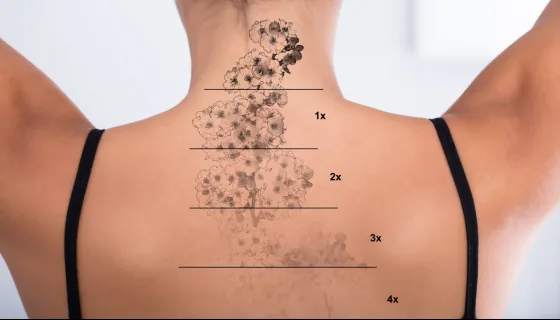
Most professional tattoos take about 8 to 12 PicoWay laser sessions to fully clear, spaced 6 to 8 weeks apart. That means complete removal usually spans roughly one to two years. Your exact count depends on ink color, density, placement, skin type, and how well your body flushes the shattered pigment.
Why removal takes months, not minutes
Getting a tattoo happens in one sitting. Removing one is a biological process that unfolds over months, because the laser does not actually take the ink out of your skin. Your body does.
When ink is tattooed into the dermis, your immune system recognizes the particles as foreign but can't move them. They are simply too large. So your body walls them off, which is exactly why a tattoo is permanent. During a PicoWay session, ultra-fast picosecond pulses of light shatter those large ink particles into microscopic fragments your white blood cells can finally carry away to the lymphatic system and flush out naturally.
That clearance is the slow part. It happens between visits, not during them, which is why patience is the single most important ingredient in a successful removal.
The six factors that decide your session count
No two tattoos, and no two immune systems, behave the same way. During your free consultation we assess these variables to give you a realistic personalized estimate rather than a marketing number.
- Ink color: Black clears the fastest because it absorbs laser energy readily. The FDA lists green, red and yellow among the hardest colors to remove, and white can be stubborn too.
- Ink density: A light amateur outline can fade in a handful of sessions, while a professional piece packed with saturated ink has far more pigment to break down.
- Location: Areas with rich blood flow, like the neck and upper body, clear faster. Hands, feet, ankles, and wrists sit farthest from the heart and fade the slowest.
- Skin type: Contrast between ink and skin matters. Deeper skin tones require more conservative, safer settings to protect natural melanin, which can add sessions.
- Scarring: Raised scar tissue from the original tattoo can shield ink from the laser and slow progress.
- Layering: Cover-ups stack ink on top of ink, so expect a count on the higher end.
Why you can't rush the interval
A common request is, "Can I come every two weeks to finish faster?" The answer is no, and it's for your benefit.
We space sessions 6 to 8 weeks apart, and sometimes longer for extremities or the final treatments. Your skin needs to fully heal to avoid scarring, and your body needs time to clear the pigment shattered at the last visit. Treating too soon just re-traumatizes healing skin and targets ink your body is already working on. Waiting the full interval, and even a bit longer, often means fewer total sessions.
Realistic timelines for common tattoos
These example scenarios show how the variables combine. They are illustrations, not promises; your consultation gives you a number specific to your ink.
| Tattoo | Estimated sessions | Approx. timeline |
|---|---|---|
| Small black script (old, light skin) | 5 to 8 | About 10 to 14 months |
| Medium color piece with green and red | 8 to 12 | Roughly 1.5 to 2 years |
| Dense black tribal band on the ankle | 10 to 15+ | 2+ years (poor circulation) |
| Fading only, for a cover-up | 3 to 5 | Under a year |
How to speed up your own results
You can't change your skin type or where your tattoo lives, but a few habits are in your control. Remember: the laser breaks the ink, and you clear it.
- Don't smoke. Smoking constricts blood vessels and blunts immune function, meaningfully slowing clearance.
- Stay active and hydrated for your general health. Neither exercise, extra water nor massage has been shown to speed ink clearance.
- Follow your aftercare closely so skin heals on time and the next session isn't delayed.
Why a flat-rate package usually wins
Because session counts are hard to predict, paying per visit is a gamble. If your tattoo turns out stubborn, per-session costs climb fast.
Our complete-removal packages cover every session needed for one fixed price, which saves roughly 38% versus paying visit by visit and removes the stress of counting sessions. You simply come in until the ink is gone. Packages are priced individually financing, with no hidden fees. Multiple tattoos are quoted at your free consultation.
The physician-led difference
Technology and technique shape your timeline. Older Q-switched lasers heat ink more slowly, which can mean more sessions, more discomfort, and greater scarring risk. Our PicoWay picosecond laser shatters ink into smaller particles more efficiently and with less heat, which supports safer treatment and faster healing between visits.
Every treatment at Laser Eraser is clinician-administered. Dr. Alvaro Alban, one of our three founding physicians, is an emergency-medicine physician who pursued specialized training at the Institute for Laser Medicine, and he customizes each PicoWay session to your skin type and ink colors. We stay honest about timelines. We won't promise three sessions if we know your tattoo needs ten.
Frequently asked questions
No. There is no safe technology that clears a professional tattoo in a single laser session. Removal is inherently a multi-session process that works with your body's natural clearance over time.
Usually the opposite. The laser targets pigment, so early sessions with lots of ink produce a stronger reaction. As the tattoo fades and less ink remains, most people find later sessions milder.
In most cases we aim for full clearance. Some colors like yellow, white, and fluorescent inks, or certain amateur mixes, can resist treatment. We'll be transparent at your consultation about the clearance you can realistically expect.
That's completely fine. You never lose progress by waiting longer, and your tattoo often keeps fading during a long break. Pausing for personal or financial reasons won't undo work already done.
Often, yes. Stalled results usually point to under-powered equipment or the wrong wavelength for your ink. Our PicoWay system can frequently restart progress on ink that stopped responding elsewhere.