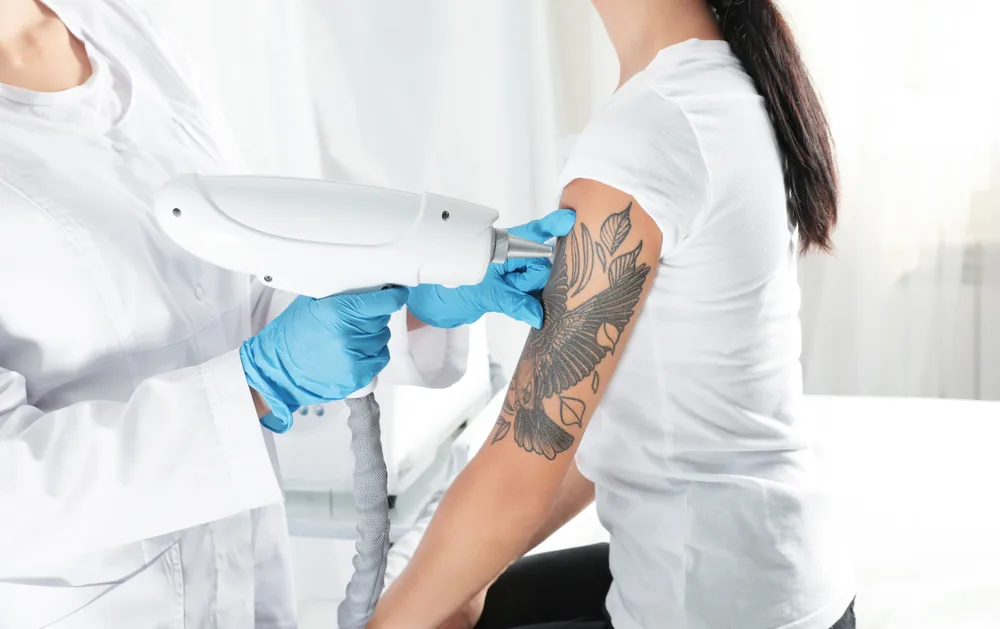
Yes. Most tattoos can be substantially or completely removed, and modern picosecond laser treatment is the safest, most effective method. It works by shattering ink into particles small enough for your body to clear. Full removal usually takes 8-12 sessions spaced several weeks apart.
The short answer, and the honest caveat
Yes, tattoos can be removed. In my practice I regularly treat everything from small script and old names to full arm sleeves, leg sleeves, and back pieces. The overwhelming majority fade dramatically, and many disappear completely.
The honest caveat is that removal is a process, not a single appointment. Ink sits deep in the dermis, and your immune system needs time between sessions to carry away the fragments a laser creates. Anyone promising to erase a tattoo in one visit is overselling. What I can promise is a realistic plan and steady, visible progress.
How the methods compare
There are a few ways to remove a tattoo, but they are not created equal. Here is how the options stack up.
| Method | How it works | Best for |
|---|---|---|
| Laser (PicoWay®) | Ultra-short pulses shatter ink into tiny particles your body clears naturally | Nearly all tattoos, all sizes and most colors |
| Surgical excision | The tattooed skin is cut out and the edges stitched together | Very small tattoos; leaves a scar |
| Dermabrasion | The skin is sanded down to reach the ink layers | Rarely used today; unpredictable results |
| Removal creams | Over-the-counter products claim to fade ink over time | Not effective; can irritate skin |
Why laser is the method I recommend
Laser removal is the most effective and widely used approach for good reason. It targets the ink without cutting or abrading the skin, so healthy tissue is largely left alone.
At Laser Eraser we use the PicoWay® picosecond laser. Older lasers deliver energy in nanoseconds; PicoWay® fires in picoseconds, which are a thousand times shorter. Those shorter pulses rely more on a photomechanical effect than raw heat, breaking ink into finer particles. Finer particles clear faster and put less thermal stress on the surrounding skin, which matters especially for patients with deeper skin tones. Every session is customized to your skin type and the specific ink colors in your tattoo.
What affects how well your tattoo comes off
No two tattoos behave exactly alike. A few factors shape how many sessions you will need and how completely the ink clears:
- Ink color: Black, brown, dark blue, and green respond best. Lighter shades like yellow and white are stubborn.
- Size and complexity: Larger, multi-color pieces take more sessions than small single-color designs.
- Age of the tattoo: Older ink has already faded somewhat and often clears more easily than fresh work.
- Skin type: Deeper skin tones need carefully adjusted settings to protect natural pigment, which is where a physician's judgment matters.
- Placement: Areas with strong circulation, like the chest and back, clear faster than the hands, feet, and lower legs.
What to expect during the process
Removal is a comfortable outpatient process. Here is the general arc from consultation to your last session.
- Consultation: A physician assesses your tattoo, skin type, and goals, then maps out a realistic plan. At Laser Eraser this consult is complimentary.
- Treatment sessions: Most tattoos take 8-12 sessions, spaced several weeks apart so skin can heal between visits. Individual sessions are quick, often around ten minutes.
- Aftercare: Simple care, keeping the area clean, using a recommended ointment, and protecting it from the sun, keeps healing on track and results looking their best.
Risks worth knowing
Laser tattoo removal is very safe, and having it performed by a licensed medical provider lowers risk further. Still, it is fair to know the possibilities. Temporary redness, swelling, or blistering can occur as skin heals. Changes in skin pigmentation are possible, particularly in darker skin, which is exactly why appropriate settings and clinical oversight matter. As with any procedure that affects the skin's surface, there is a small infection risk that good aftercare minimizes. We review all of this openly at your consultation, no surprises.
The physician-led difference
Many tattoo-removal chains hand the laser to a technician. At Laser Eraser, treatment is clinician-administered. My background is in emergency medicine, and I pursued specialized laser training at the Institute for Laser Medicine in Skippack, Pennsylvania before founding the practice.
That matters most when a case is not straightforward, deeper skin tones, stacked cover-ups, or reactive ink, because the settings can be adjusted in real time by someone trained to read the skin's response. We also keep pricing transparent: flat-rate complete-removal packages that cover every session you need, financing tailored to your tattoo, and roughly 38% savings versus paying session by session.
Frequently asked questions
Most tattoos take 8-12 sessions to fully remove, spaced several weeks apart to let the skin heal. The exact number depends on the tattoo's size, ink colors, age, and your skin type, which we estimate at your free consultation.
Nearly all colors respond, but not equally. Black, brown, dark blue, and green clear most readily, while yellow and white are the most stubborn. We tailor the PicoWay® settings to your specific ink.
Most patients find it more tolerable than expected, and many say it is easier than the tattoo itself. Sessions are brief, often around ten minutes, and we take steps to keep you comfortable.
Laser removal is designed to clear ink while sparing healthy skin, so scarring is uncommon, unlike surgical excision or dermabrasion. Following your aftercare instructions keeps skin healing cleanly.
We offer flat-rate complete-removal packages that cover every session you need, with financing tailored to your tattoo and about 38% savings versus paying per session. You get an exact quote at your complimentary consultation.