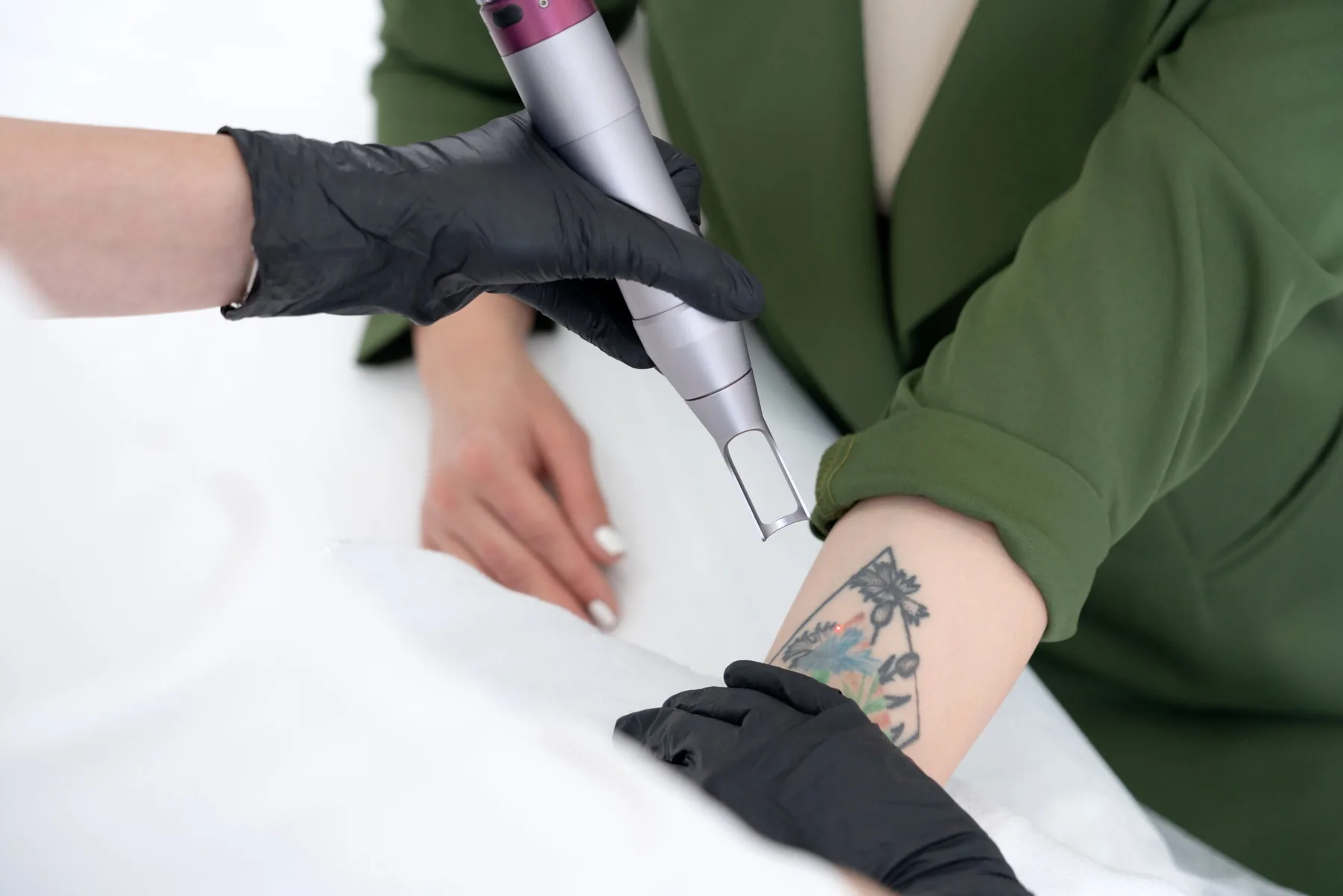
Laser removal uses a PicoWay picosecond laser to shatter ink so your body clears it, while saline removal opens the skin and draws pigment out through a scab. For most tattoos, laser is the safer, more predictable choice with lower scarring risk; saline is mainly used for shallow cosmetic tattoos.
The Quick Verdict
If you are removing a body tattoo of almost any size, color, or age, laser removal with a PicoWay picosecond laser is the more effective and lower-risk option. It reaches ink at every depth, works across a wide range of colors, and clears pigment through your body's own lymphatic system rather than forcing it out through an open wound.
Saline removal still has a legitimate place, mostly for shallow cosmetic tattoos like microblading, lip blush, and older permanent makeup where the pigment sits close to the surface. Below, we lay out how each method actually works and where the honest trade-offs are so you can decide with your eyes open.
How Each Method Works
Laser removal is a non-abrasive process. The PicoWay laser delivers ultra-short picosecond pulses of light that are absorbed by the tattoo pigment and shatter it into microscopic particles. Your immune system then gradually filters those particles away over the weeks between sessions. The surface of your skin is left intact, which is a large part of why scarring risk stays low when the treatment is performed correctly.
Saline removal is a tattooing-in-reverse technique. A technician uses a tattoo machine to open the top layers of skin and deposit a saline (salt-based) solution, which draws pigment toward the surface. As the area heals, a scab forms and some ink lifts away with it. Because the method depends on wounding and scabbing the skin, aftercare is more involved and the outcome is harder to predict, especially on deeper or professionally applied body ink.
Side-by-Side Comparison
Here is how the two methods stack up on the factors that matter most. We have tried to be fair to saline where it earns it, and honest about where the PicoWay laser has a real advantage.
| Factor | Laser (PicoWay) | Saline |
|---|---|---|
| Mechanism | Picosecond light shatters ink; body clears it internally | Skin is opened and salt solution draws pigment out via scabbing |
| Typical sessions | Around 8–12 for complete removal of a body tattoo | Often more sessions on deeper ink; best for shallow work |
| Pain | Brief; most patients tolerate it well, cooling used | Comparable to getting tattooed, plus a longer heal/scab |
| Scarring risk | Low when performed correctly; surface stays intact | Higher — relies on wounding and scabbing the skin |
| Skin-tone safety | Settings customized per skin type and ink color | Marketed as tone-neutral, but healing/scar risk still applies |
| Best for | Nearly all body tattoos, multi-color and dark ink | Shallow cosmetic tattoos: microblading, lip blush, PMU |
| Cost | Flat-rate Complete Removal Packages tailored to your tattoo | Varies by studio; usually priced per session |
| Availability | Clinician-administered at Laser Eraser in NJ | Offered mainly at brow/PMU studios and some spas |
Where Saline Is a Reasonable Choice
We do not think saline is a scam, and we will tell you plainly when it may make sense. For very superficial cosmetic tattoos — recent microblading, some lip blush, and lightly implanted permanent makeup — the pigment sits shallow enough that a saline lift can work, and it avoids concerns some clients have about lasers near the eyes or lips.
That said, results depend heavily on the technician's skill, the depth and type of pigment, and how your skin heals. Cosmetic inks can also contain iron-oxide and titanium-dioxide compounds that behave unpredictably, which is exactly why any pigment-lightening plan should start with an in-person assessment rather than a booking button.
Why We Lead With Laser
For body tattoos, the picosecond advantage is not marketing. The PicoWay laser's extremely short pulse duration breaks pigment into finer particles than older nanosecond lasers, which tends to mean more efficient clearance across more ink colors — including stubborn blues, greens, and dense blacks — while keeping surrounding tissue calmer.
Just as important is who is holding the device. At Laser Eraser, every treatment is clinician-administered. Founder Dr. Alvaro Alban brings an emergency-medicine background and specialized training from the Institute for Laser Medicine, and settings are customized to your skin type and ink. That combination of the right technology and medical oversight is what keeps expectations realistic and scarring risk low. No method guarantees complete removal for every tattoo, and we will be candid about your specific case at a free consultation.
Complete Removal Packages by Size
8–12 sessions · every session includedOne flat price covers all the sessions your tattoo needs — no per-visit billing. Every tattoo is priced individually, so we give you an exact quote free at your consultation.
Every tattoo is priced individually. Book a free consultation for your exact quote — no obligation.
Get Your Free QuoteFrequently asked questions
Laser is better for almost all body tattoos because it clears ink at every depth without wounding the skin, giving lower scarring risk and more predictable fading. Saline is best reserved for shallow cosmetic tattoos like microblading or lip blush, where pigment sits close to the surface.
Saline generally carries higher scarring risk because it works by opening the skin and forcing a scab to lift pigment, which is essentially a controlled wound. PicoWay laser removal leaves the skin surface intact and shatters ink internally, so scarring risk stays low when the treatment is performed correctly by an experienced provider.
Saline is a poor fit for large or professionally applied color tattoos because that ink is deep and dense. Laser removal with a PicoWay handles multi-color and dark ink far more effectively, typically over about 8 to 12 sessions. For body pieces, we recommend laser and will confirm the right plan at your consultation.
Laser Eraser offers flat-rate Complete Removal Packages tailored to your tattoo that cover all sessions needed, so your total is known upfront and can save around 38% versus per-session pricing. Saline is usually billed per session at PMU studios, which makes the final cost harder to predict on stubborn ink.
Both involve some discomfort. Laser pulses feel brief and snappy, and cooling is used to keep you comfortable; most patients tolerate it well. Saline feels similar to being tattooed and is followed by a longer scabbing and healing phase, so day-to-day recovery discomfort can last longer than with laser.