Tattoo removal creams do not work to remove a tattoo. They cannot reach the ink sitting in the deep dermis, so at best they lightly bleach or peel the top layer of skin while the design stays put. Laser removal with a PicoWay picosecond laser is the only proven, physician-controlled way to actually clear the ink.
The quick verdict
If you are hoping a bottle from the internet will erase your tattoo, the honest answer is that it will not. Tattoo ink is deposited deep in the dermis, well below the reach of any topical product, and a cream simply cannot travel down to where the pigment lives. What these products actually do, when they do anything at all, is act on the surface, bleaching or exfoliating the outer skin so the tattoo may look marginally lighter for a while.
Laser removal takes the opposite approach. Instead of working from the top down, the PicoWay picosecond laser sends energy straight to the ink itself and shatters it into particles small enough for your body to carry away. That is the fundamental reason lasers remove tattoos and creams do not. We want you to make an informed choice, so below is a fair, side-by-side look at both.
Side-by-side comparison
Here is how over-the-counter tattoo removal creams stack up against professional laser removal on the factors that matter most. We have tried to represent the creams fairly rather than dismiss them outright, but the differences in how each one works largely determine the outcome.
| Factor | Tattoo Removal Creams | PicoWay Laser Removal |
|---|---|---|
| Mechanism | Bleaches or peels the surface skin; cannot reach ink in the dermis | Picosecond pulses shatter the deep ink into particles your body clears |
| Actually removes the tattoo | No, ink stays in place; only surface tone changes | Yes, this is the proven, standard method for clearing ink |
| Sessions / timeline | Daily use for months with little to no real fading | Typically 8 to 12 spaced sessions for complete removal |
| Pain | Often causes stinging, burning, or chemical irritation over time | Quick sessions, many patients compare it to a rubber band snap |
| Scarring risk | Higher; harsh acids and peeling agents can irritate and scar skin | Low when performed by a licensed medical provider who reads your skin's response |
| Skin-tone safety | Unpredictable; may bleach or blotch surrounding skin | Settings customized to your skin type to protect surrounding tissue |
| Cost | Cheap per bottle, but wasted money since it does not work | Flat-rate Complete Removal Packages tailored to your tattoo, financing available |
| Who oversees it | None; unregulated self-treatment at home | A licensed medical provider performs and supervises every treatment |
Why creams cannot reach the ink
To understand why creams fall short, it helps to know where a tattoo lives. When you were tattooed, an artist deposited ink into the dermis, the deeper layer of skin beneath the surface epidermis. That depth is exactly what makes a tattoo permanent and, unfortunately for topical products, exactly what puts the ink out of a cream's reach. A lotion sits on and just below the surface; it does not penetrate down to the pigment.
So what are these creams doing when a tattoo looks a little lighter? Most rely on exfoliating acids or bleaching agents like hydroquinone that act on the epidermis. They can lighten the skin tone and slough off surface cells, which may give a faint impression of fading, but the design itself remains fully intact underneath. Some products are also harsh enough to cause chemical burns, prolonged irritation, uneven pigmentation, or scarring, which can leave the tattoo looking worse rather than gone.
How the PicoWay laser actually clears ink
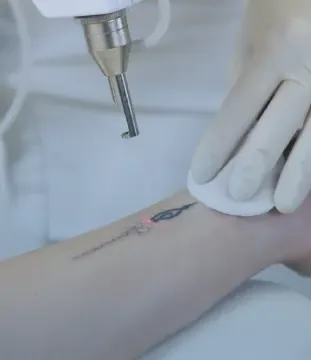
Laser Eraser uses the PicoWay picosecond laser, the core technology behind every tattoo treatment we perform. A picosecond is one trillionth of a second, and PicoWay fires its pulses in that window. Those ultra-short bursts hit the ink with a photoacoustic effect, essentially a tiny pressure shockwave, that breaks the pigment into microscopic dust rather than simply heating it. The finer those particles, the more efficiently your immune system flushes them away through the lymphatic system over the following weeks.
In fairness to the alternatives, PicoWay is not magic and we will not overpromise. Complete removal still takes a series of sessions, usually 8 to 12, and results build gradually rather than overnight. But it is the genuine, evidence-based method for removing a tattoo, and its picosecond speed gives it a real advantage over older nanosecond lasers, particularly on stubborn colors like blues and greens and on a wider range of skin tones. The wavelength and settings are customized to your specific ink colors and skin type at each visit.
- Picosecond pulses shatter ink at the source, where creams cannot reach
- Particles are cleared naturally by your immune system over the weeks after each session
- PicoWay handles a broad range of colors, including hard-to-treat blues and greens
- Settings are tuned to your skin type to protect the surrounding skin
Being fair to the creams
There are a couple of honest points in the creams' favor, and it would be misleading to ignore them. They are inexpensive up front, they are painless to buy, and they can be used privately at home without an appointment. For someone who only wants to slightly soften the look of a tattoo and is not committed to removing it, a gentle product may produce a barely perceptible change.
The problem is that none of that adds up to actual removal. Money spent on months of daily application is money spent on a result the product physically cannot deliver, and the harsher formulas carry a real risk of irritation and scarring. When people weigh the true cost, the low sticker price of a cream that does not work compares poorly against a flat-rate laser package that does, especially with financing that spreads the cost into manageable monthly payments.
Why a licensed medical provider performs your removal
One of the biggest differences between a cream and professional laser removal is oversight. A cream is unregulated self-treatment with no one watching how your skin reacts. At Laser Eraser, a licensed medical provider performs every treatment, not a technician, which is a genuine difference from the spas and franchise chains where laser work is often delegated to non-physician staff.
Founder Dr. Alvaro Alban is an emergency-medicine physician in New Jersey who pursued specialized training at the Institute for Laser Medicine in Skippack, Pennsylvania, with a focus on laser tattoo removal including large and multi-color pieces, full back pieces, and arm and leg sleeves. That medical judgment matters most when the situation is not textbook, such as darker skin tones, stubborn colors, or sensitive placements, and it is exactly the safeguard a home cream can never provide.
Complete Removal Packages by Size
8–12 sessions · every session includedOne flat price covers all the sessions your tattoo needs — no per-visit billing. Every tattoo is priced individually, so we give you an exact quote free at your consultation.
Every tattoo is priced individually. Book a free consultation for your exact quote — no obligation.
Get Your Free QuoteFrequently asked questions
No, tattoo removal creams do not remove tattoos. The ink sits deep in the dermis, far below where any topical product can reach, so a cream only bleaches or peels the surface skin while the design stays intact. Laser removal with the PicoWay picosecond laser is the proven way to actually clear the ink.
Many tattoo removal creams carry real risks. The acids and bleaching agents they rely on can cause chemical burns, prolonged irritation, uneven skin pigmentation, and even scarring, sometimes leaving the area looking worse than before. Because they are unregulated self-treatment with no medical oversight, we recommend a physician-supervised laser consultation instead.
Laser removal actually works because it targets the ink itself rather than the skin surface. The PicoWay laser shatters deep pigment into particles your body clears naturally, something no cream can do from the top down. Laser treatment is also physician-controlled, with settings customized to your skin type and ink colors to protect the surrounding skin.
Yes, because a cream that cannot remove your tattoo is money spent for no real result. Laser removal delivers genuine, lasting clearance, and Laser Eraser offers flat-rate Complete Removal Packages tailored to your tattoo with financing available. When you compare the true value, a package that works costs far less than repeatedly buying a product that does not.
We do not recommend it. Creams do not meaningfully fade ink and the harsher ones can irritate or scar the skin, which may complicate later laser treatment. If you want to remove or fade a tattoo, including prep for a cover-up, start with a free consultation so a physician can plan safe, effective PicoWay sessions.