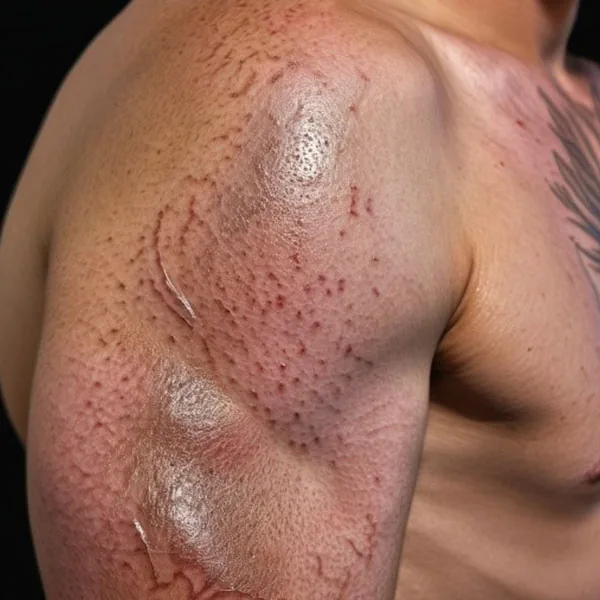
Hypertrophic scar treatment in NJ uses a physician-calibrated laser to target the redness inside a raised scar and prompt the body to reorganize the excess collagen that makes it thick and firm. At Laser Eraser, a licensed medical provider performs every session with the PicoWay laser, flattening and fading the scar gradually over a series of visits, typically three to six.
Hypertrophic Scars vs. Keloids
A hypertrophic scar is a raised, thickened scar that stays inside the borders of the original wound. That boundary is the single clearest way to tell it apart from a keloid, which keeps growing outward past the injury and onto healthy surrounding skin. Both are the result of the body laying down more collagen than it needs while healing, but a hypertrophic scar respects the edges of the cut, burn, or breakout that caused it.
The distinction matters clinically, not just as a label. Hypertrophic scars are generally less prone to regrowth than keloids, and many soften and flatten somewhat on their own over the first year or two after an injury. Plenty of them stay raised, firm, and noticeably red or pink well past that window, though, which is when people start looking for treatment. Your physician confirms which type of scar you actually have before recommending anything.
Where Hypertrophic Scars Form and Why
These scars tend to appear where skin is under tension. The chest, shoulders, upper back, and areas that stretch across a joint are common sites, because every movement tugs at the healing wound and signals the body to reinforce it with more collagen. They also follow predictable triggers: surgical incisions, burns, deep acne, piercings, and lacerations that took time to close.
A hypertrophic scar usually declares itself within weeks of the original injury rather than months later, rising and reddening as the wound matures. Beyond how it looks, it can itch, feel tight, or stay tender to the touch, particularly in the early stages. Those symptoms are worth mentioning at your consultation, since they help your physician judge how active the scar still is.
How Laser Treatment Helps
Laser treatment addresses a hypertrophic scar on two fronts at once. The first is color: focused energy targets the dilated blood vessels feeding the scar, which is what drives the persistent red or pink tone and helps the scar settle closer to your natural complexion. The second is structure: controlled energy triggers a remodeling response, prompting your body to break down the dense, disorganized collagen bundles inside the scar and rebuild smoother, better-organized tissue underneath.
At Laser Eraser we use the PicoWay picosecond laser, the same precision platform behind our tattoo removal work, calibrated differently for scar tissue. Its ultra-short pulses place energy in tiny, high-impact bursts that act on the scar while limiting heat spread into the skin around it. Because the change comes from your own healing response, improvement is progressive — texture and color shift gradually across a course of sessions rather than after any single appointment.
- Targets the blood vessels behind persistent redness and pink tone
- Stimulates collagen remodeling to flatten and soften raised tissue
- Can ease itching, tightness, and tenderness in an active scar
- Picosecond precision focuses energy on the scar, not the surrounding skin
Why a Licensed Medical Provider Calibrates Every Session
Raised scars are unforgiving of guesswork. Settings that are too aggressive can irritate tissue that is already inflamed, while settings that are too cautious produce little visible change. That is why every treatment at Laser Eraser is performed by a licensed medical provider rather than handed to a technician. Our founder, Dr. Alvaro Alban, is a New Jersey emergency-medicine physician who pursued specialized laser training at the Institute for Laser Medicine in Skippack, Pennsylvania.
Before choosing any settings, a doctor evaluates the age, thickness, color, and location of your scar alongside your skin type and how you have healed in the past. A young, actively red scar is approached differently than one you have had for a decade. That medical judgment also shapes how far apart sessions are spaced and when a plan should be adjusted or paused — and it means an honest answer about what laser treatment can and cannot do for your particular scar.
Honest Expectations: Sessions and Results
Hypertrophic scar treatment is a course, not a single visit. Most people need a series of sessions, often in the range of three to six, spaced several weeks apart so the skin can respond and remodel between appointments. Thicker, older, or larger scars may need more. Rather than quote a fixed number up front, your physician gives you a realistic range at your free consultation after actually examining the scar.
We would rather be straightforward than oversell. Laser treatment can meaningfully flatten, soften, and fade a hypertrophic scar, but no responsible provider can promise that a scar will disappear completely. Some respond dramatically, others improve more modestly, and results depend on the scar's age and depth and on how your individual skin heals. Because scar treatment is cosmetic, it is generally not covered by insurance, which is why we offer a complimentary consultation and flexible monthly payment plans with no hidden fees.
Safety Across Skin Tones
Skin tone is a central part of planning any scar treatment. Deeper and richer complexions carry more melanin, which can make some lasers more likely to cause unwanted lightening or darkening if the device or the settings are not chosen carefully. The PicoWay platform's picosecond pulses were designed to deliver energy precisely and limit excess heat in surrounding tissue, which supports a more measured approach across a wider range of skin types.
The technology is still only as safe as the person operating it. Your physician assesses your skin type before treatment begins, starts conservatively, and watches how your skin responds before advancing. If you have a history of keloids or of pigment changes after an injury, tell us at your consultation so it can be factored into your plan — or so we can tell you honestly if laser treatment is not the right fit for your scar.
Frequently asked questions
A hypertrophic scar stays within the borders of the original wound, while a keloid grows outward past the injury onto healthy surrounding skin. Both come from excess collagen during healing, but hypertrophic scars are generally less prone to regrowth and often soften somewhat on their own. Your physician confirms which type you have before recommending treatment.
Most people need a series of sessions, often three to six, spaced several weeks apart so the skin can remodel between visits. Thicker, older, or larger scars may require more. Rather than quote a fixed number in advance, our physician gives you a realistic range after examining your scar and skin at your free consultation.
Laser treatment can meaningfully flatten, soften, and fade a hypertrophic scar, but complete removal cannot be guaranteed. Results depend on the scar's age, thickness, and location, and on how your individual skin heals. Our goal is genuine, visible improvement, and your physician will tell you plainly what to expect for your specific scar.
Yes, when it is properly calibrated by a physician. The PicoWay laser's picosecond pulses deliver energy precisely and limit excess heat, which supports treating a wider range of complexions. Your doctor reviews your skin type and healing history first, starts conservatively, and monitors your response before adjusting settings.
It depends on the scar. Some hypertrophic scars flatten on their own during the first year or two, while others stay raised and red. Timing is a medical judgment based on how active the scar still is, so bring it to a free consultation and your physician will advise whether to treat now or monitor it first.