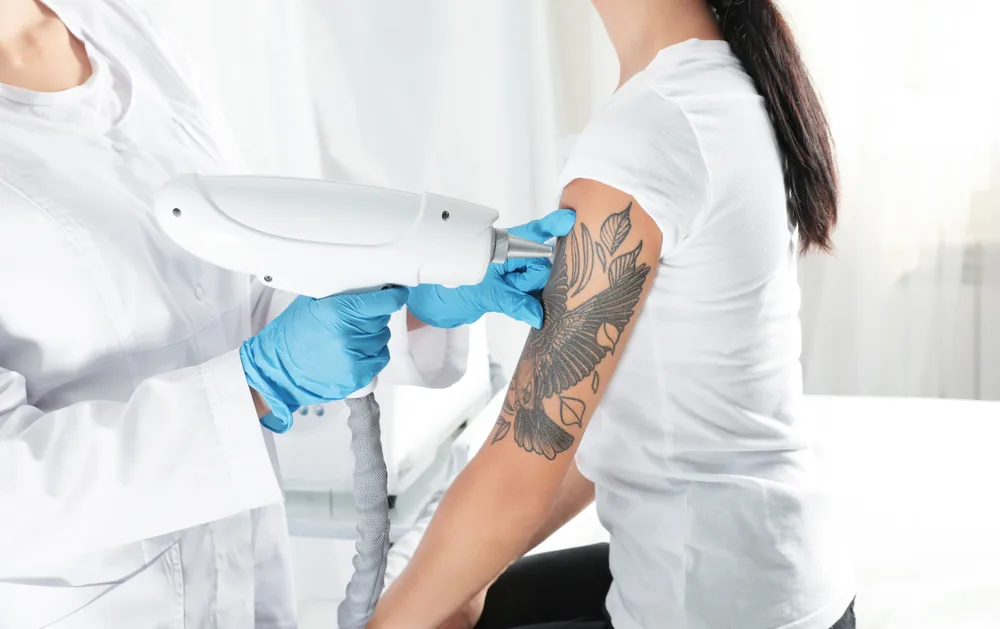
The best laser tattoo removal comes from a picosecond laser like the PicoWay run by a licensed medical provider, not a generic device at a spa. Picosecond pulses shatter ink into finer particles your body clears faster, meaning fewer sessions, better color clearance, and lower scarring risk across skin types.
Not all lasers are the same
Many people assume laser tattoo removal is a single, standardized service and that every clinic works the same way. It is not. The market runs from outdated, underpowered handpieces to true medical-grade systems, and the gap between them shows up directly on your skin.
The most useful question to ask any provider is not "how much?" It is "what technology do you use, and who is operating it?" At Laser Eraser in Clark and Paramus, New Jersey, the answer is a PicoWay picosecond laser, operated in a physician-led practice founded by three physicians — Dr. Alvaro Alban, Dr. Len Hobson, and Dr. Dominic Ruocco.
From burning to shattering: how removal evolved
Older removal methods, sanding, salting, or cutting the skin out, worked by destroying tissue along with the ink, trading a tattoo for a permanent scar. Early continuous-wave lasers were only marginally better; they burned the surface to reach pigment and often left texture and color changes behind.
Q-switched lasers were a real leap. Instead of burning continuously, they pulse in nanoseconds (billionths of a second), heating ink fast enough to fracture it before heat spreads. They are still widely used, but they can struggle with certain colors and stubborn ink and can build up heat on sensitive skin.
Picosecond technology is the next step. A picosecond is a trillionth of a second, roughly a thousand times faster than a nanosecond. At that speed the laser adds a photo-acoustic (pressure) effect on top of heat, delivering a mechanical shockwave that pulverizes ink into a much finer dust your body can flush more easily.
What better technology means for your result
The physics is interesting, but what matters is what it does for your skin and your schedule.
- Potentially fewer sessions: finer ink particles are easier for your immune system to clear, so many patients see meaningful fading in fewer visits than with older lasers.
- Better color clearance: matching wavelength to ink color helps target reds, oranges, blues, and greens, not just black outlines.
- Safer across skin tones: ultra-fast pulses transfer less heat to surrounding pigment, an important factor for darker (Fitzpatrick IV-VI) skin.
- Gentler recovery: relying more on shockwave than sustained heat means less trauma to surrounding tissue, though some redness and swelling between sessions is normal.
Matching the laser to your ink
Color is physics. Different ink colors absorb different wavelengths of light, so a single-wavelength machine that clears a black outline may leave a red rose or a blue-green watercolor almost untouched.
The PicoWay is tuned to the color and depth of your specific tattoo and to your skin type. Whether your piece is simple black script or a multi-color sleeve, the settings are chosen for what is actually in your skin, not a one-size-fits-all preset.
The physician makes the difference
Even the best laser is only as good as the hands running it. A Class IV medical laser in untrained hands is a real risk; used with judgment, it is precise and predictable.
Laser Eraser is physician-led. Dr. Alvaro Alban is a New Jersey emergency-medicine physician who pursued specialized laser training at the Institute for Laser Medicine in Skippack, Pennsylvania, with a focus on complex work including large multi-color pieces, full back pieces, and arm and leg sleeves. Every session is customized: how your skin responded last time, how much ink remains, any tanning or skin-tone changes, and the location on your body all shape the settings. That clinician-administered approach is a genuine difference from franchise and spa competitors.
Why quality technology can cost less overall
It sounds backward, but efficient removal is usually the cheaper path. A budget device may take far more sessions to reach the same fading, meaning more visits, more months of healing, and more total cost, sometimes without ever fully clearing the ink.
Laser Eraser prices removal as a single flat-rate package that covers all the sessions your tattoo needs for complete removal, typically 8 to 12 sessions depending on ink, placement, and skin type. That complete package saves about 38% versus paying per session. Financing is priced individually for an extra-small piece, with no hidden fees, and larger tattoos are quoted at a free consultation. Multiple tattoos get a custom package quote.
Honest expectations
No responsible provider can guarantee that every tattoo will disappear completely; results depend on ink, depth, colors, placement, and how your body clears pigment. Sessions are spaced several weeks apart because your immune system, not the laser, does the actual clearing, and it needs time between visits.
The most reliable way to know what your removal will involve is a free, no-pressure consultation. We assess your tattoo in person, explain how the PicoWay will treat it, and give you a realistic roadmap before you commit to anything.
Frequently asked questions
The two biggest factors are the laser and the operator. A picosecond laser such as the PicoWay clears ink more efficiently and more safely than older nanosecond devices, and a physician-led practice can tailor the settings to your specific ink and skin type at each visit.
Most tattoos take about 8 to 12 sessions for complete removal, though this varies with ink color and density, placement, and your skin type. We give you a realistic estimate at your free consultation.
Most people describe the sensation as a rubber-band snap. Treatments are quick, and we use cooling during the session to keep it comfortable. Many patients find it more tolerable than they expected.
The laser breaks the ink apart, but your immune system carries the particles away, and that takes time. Spacing sessions several weeks apart lets your skin recover and your body finish clearing debris before the next treatment.
Yes. Matching wavelength to ink color helps clear reds, blues, and greens, not just black, and the fast picosecond pulses transfer less heat, which makes treatment safer across a range of skin tones. Your plan is customized at consultation.