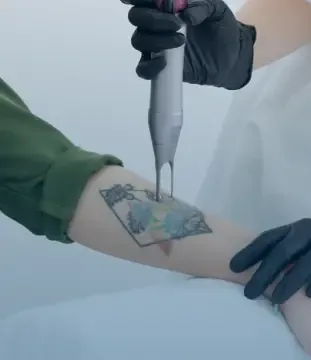
No. There is no credible scientific evidence that laser tattoo removal causes cancer. Medical lasers like the PicoWay® are non-ionizing and emit no UV radiation, so they cannot damage DNA the way sunlight or tanning beds can. They simply shatter ink particles for your body to clear.
Why the lasers used can't cause cancer
The fear is understandable: "laser" and "cancer" sound like they belong in the same sentence. But the physics tell a reassuring story. Cancer-causing radiation is ionizing radiation, meaning it carries enough energy to knock electrons loose and mutate the DNA inside your cells. X-rays, radon, and ultraviolet (UV) light from the sun all fall into that category.
The lasers used in tattoo removal are the opposite. The PicoWay® picosecond laser we use is non-ionizing and emits no UV rays. It delivers ultra-short pulses of light tuned to specific wavelengths that are absorbed by tattoo pigment, not by your DNA. The energy shatters the ink into tiny fragments that your immune system then flushes away over the following weeks. There is no mechanism by which this process can trigger the genetic mutations that lead to cancer.
What the science actually shows
Laser tattoo removal has been studied and practiced for decades, and the research consistently fails to find a link to cancer. Because these devices do not emit UV radiation, they do not carry the skin-cancer risk associated with sun exposure or tanning beds.
One question researchers have looked at is whether breaking apart ink chemically could create harmful byproducts. Some tattoo inks do contain compounds that, in a laboratory setting, can fragment into other molecules. The important context: the amounts are extremely small, they are cleared by the body, and no study has shown that they cause cancer in people undergoing removal. The consensus in the medical literature remains that laser tattoo removal is safe when performed correctly.
The real risks worth knowing
Being honest about safety means being honest about the side effects that are real. None of these are cancer, and most are temporary, but you should know what to expect.
- Temporary redness, swelling, and occasional blistering in the treated area, which usually settles within days.
- Increased sun sensitivity right after a session. Protect the area with clothing and sunscreen and avoid direct sun.
- Pigment changes (lightening or darkening of the skin), which are more likely when the wrong settings are used on darker skin tones or when an inexperienced operator runs the laser.
- Rare scarring, most often tied to aggressive settings or poor aftercare rather than the laser itself.
The one situation where you should pause
There is a scenario worth taking seriously. If there is a mole, an unusual spot, or a suspicious lesion hidden underneath or beside your tattoo, that skin needs to be evaluated before any laser touches it. Firing a laser over an undiagnosed skin cancer is never appropriate, and lasering an area that should be examined can delay a diagnosis.
This is exactly why a physician-led evaluation matters. During your consultation, Dr. Alvaro Alban and our team examine the skin, review your history, and flag anything that needs a dermatologist's attention before we begin. That is a step many walk-in tattoo shops and spas simply skip.
Why who holds the laser matters
The lasers we use are FDA-cleared, but a device is only as safe as the hands operating it. Laser Eraser is physician-led: Dr. Alvaro Alban brings an emergency-medicine background and specialized training from the Institute for Laser Medicine in Skippack, Pennsylvania. Every treatment is clinician-administered and the settings are customized to your skin type and ink colors, which is precisely how you minimize the pigment changes and scarring risks above.
That medical oversight, paired with the PicoWay® picosecond platform, is the difference between a safe, controlled procedure and guesswork.
Frequently asked questions
No. The lasers do not emit ultraviolet radiation, which is the type of light linked to skin cancer. They are non-ionizing and cannot cause the DNA damage that leads to cancer.
The laser fragments ink into tiny particles your immune system clears naturally. The amounts involved are very small, and no study has shown that this process causes cancer in people.
Yes. We use the FDA-cleared PicoWay® picosecond laser. Just as important, every treatment is administered by a licensed medical provider and customized to your skin and ink.
Tell us at your consultation. Any suspicious mole or lesion should be evaluated before we treat the area, and we screen for this as part of our physician-led process.
Most tattoos take 8–12 sessions to fully remove, depending on ink colors, placement, and skin type. Our flat-rate packages cover all the sessions you need, with financing tailored to your tattoo.