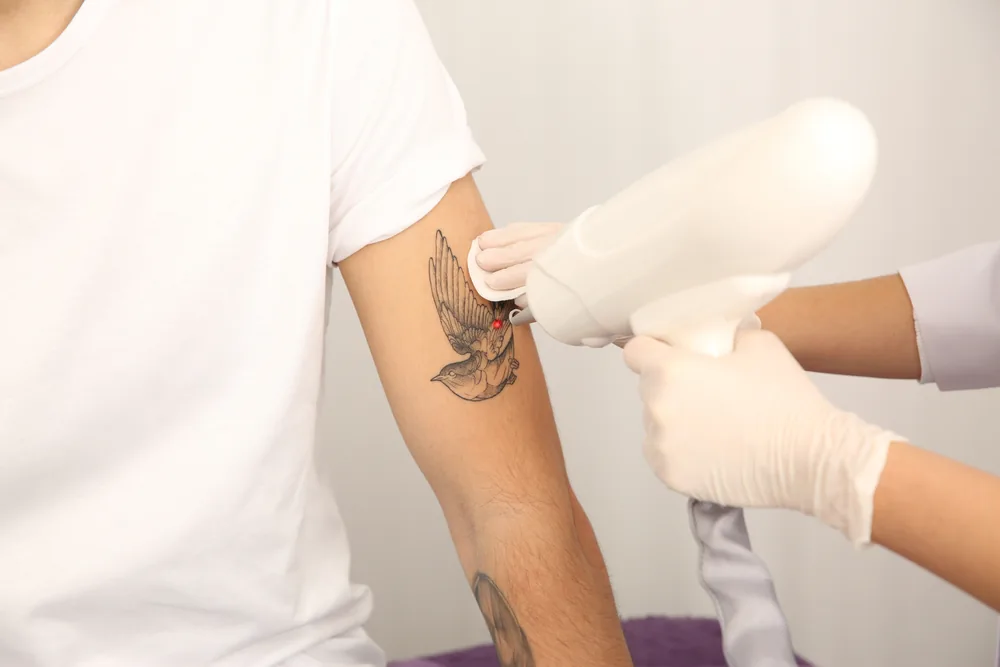
If a tattoo blocks your enlistment, start removal early. Most military branches disqualify tattoos on the face, neck, and hands. Laser removal takes several sessions spaced 6–8 weeks apart, so a realistic plan runs 6–18 months before you ship. At Laser Eraser in NJ, physician-led PicoWay treatment can begin fading a disqualifying tattoo right away, with flat-rate packages tailored to your tattoo.
Can a tattoo really disqualify you from enlisting?
Yes — but placement and content matter far more than simply having tattoos. Every U.S. military branch now allows tattoos on most of the body, and policies have generally loosened in recent years to widen the recruiting pool. What stays restricted are highly visible locations — the face, neck, and hands — plus any tattoo that is extremist, racist, sexist, gang-related, or otherwise prejudicial to good order and discipline, which is barred regardless of where it sits.
The practical takeaway for a New Jersey recruit is this: if you have ink on your neck, hands, or face, or a piece with content that could be flagged, confirm the current standard with your recruiter early — then, if removal is the path forward, begin as soon as possible. Laser removal is a process measured in months, not weeks, so the recruits who plan ahead are the ones who ship on schedule.
Current branch tattoo policies at a glance
Tattoo policy is set at the branch level and is updated periodically, so the summary below reflects the general framework each service has used in recent policy — always verify the exact current wording with your recruiter or MEPS, since details change year to year. The consistent theme across all five branches is that visible-when-in-uniform locations (face, neck, hands) are the most restricted, while sleeves, chest, back, and legs are broadly permitted.
Content rules are universal and non-negotiable: no matter the branch, tattoos that are extremist, supremacist, gang-affiliated, sexually explicit, or that advocate discrimination are disqualifying and cannot simply be waived — they typically must be removed or covered. That category is exactly where laser removal becomes a requirement rather than a personal preference.
- Prohibited content (extremist, gang, discriminatory, explicit) is disqualifying in every branch, at any location.
- Hand and neck allowances, where they exist, are usually capped by size (for example, a single small band or a limited-dimension piece).
- Finger ring tattoos and small behind-the-ear pieces are often treated more leniently than full hand or neck coverage.
- Officer and special-program standards (aviation, special operations) can be stricter than general enlistment.
| Branch | General posture on visible tattoos | Most-restricted locations |
|---|---|---|
| Army | Broadly permissive on body; limited allowances on hands/neck under size limits | Face, most of neck, inside eyelids |
| Navy | Among the most tattoo-friendly; neck and behind-ear allowed within size limits | Face; oversized neck/head ink |
| Marine Corps | Historically the strictest; detailed size/placement rules | Neck, hands, face; large visible pieces |
| Air Force | Removed the '25% coverage' rule; hand/neck limited | Face, head, neck, hands (with narrow exceptions) |
| Coast Guard | Similar to Navy; visible-in-uniform limits apply | Face, neck, hands beyond allowed size |
Which tattoo locations most often need removal
The tattoos that derail enlistments cluster in a predictable set of high-visibility zones. If your ink is here, it is worth confirming the standard with your recruiter before you count on a waiver.
Location also affects removal itself. Tattoos on the neck and face sit over well-perfused skin and often respond efficiently to laser treatment, while hands and fingers have slower circulation and thinner skin, which can mean more sessions and a more conservative pace. A physician factors this into your plan so the treatment matches the area.
- Face — restricted in every branch; almost always must be removed to qualify.
- Neck — the most common enlistment blocker; allowances are narrow and size-limited.
- Hands and fingers — frequently flagged; removal here is slower and needs careful settings.
- Any location — content-based disqualifiers (gang, extremist, explicit) regardless of where they sit.
- Behind the ear and finger bands — often permitted, but confirm the current size limits.
Timeline: how early to start before you ship
This is the single most important planning fact: laser tattoo removal is not a one-visit fix. Sessions are spaced roughly 6–8 weeks apart so your skin heals and your body clears shattered ink between treatments. Because most tattoos take multiple sessions to fully clear, the full arc from first session to complete removal commonly runs well over a year — which is why starting early is everything.
The good news for enlistees is that full removal is often not required to qualify. In many cases a tattoo only needs to be faded enough, or partially cleared, to fall within a branch's size or visibility standard — and meaningful fading typically shows within the first few sessions. If your goal is 'get this neck piece within policy' rather than 'erase every trace,' your working timeline can be considerably shorter than a complete removal.
Map your plan backward from your intended ship date. Talk to your recruiter about exactly what needs to change, then build in enough 6–8-week cycles to get there with margin. Starting the moment you know you want to enlist — rather than after you have a ship date locked — gives you the most flexibility.
| Your goal | Typical session cadence | Plan-ahead window |
|---|---|---|
| Fade a small tattoo within policy | 6–8 weeks apart | ~6–9 months before shipping |
| Partial removal to meet size limits | 6–8 weeks apart | ~9–12 months before shipping |
| Complete removal of a visible piece | 6–8 weeks apart | ~12–18+ months before shipping |
Why PicoWay fades tattoos faster for enlistees in a hurry
When the calendar is your enemy, the laser matters. Laser Eraser treats exclusively with the PicoWay picosecond laser, which delivers energy in ultra-short picosecond pulses. Those shorter pulses shatter ink into finer particles than older nanosecond (Q-switched) lasers, and finer particles are cleared more efficiently by your body between sessions — which is exactly the mechanism that drives visible fading.
PicoWay is also a dual-wavelength system tuned to your skin type and the specific ink colors in your tattoo. Black and dark blue — the most common colors in the neck, hand, and lettering tattoos that block enlistments — respond fastest of all, which works in an enlistee's favor. There are no guarantees of a specific session count for any individual, but for time-sensitive recruits, a picosecond platform in a licensed medical provider's hands is the setup most likely to reach 'within policy' on the tightest realistic schedule.
Estimating your session count: the Kirby-Desai scale
Clinicians often estimate laser tattoo removal sessions using the Kirby-Desai scale, a scoring tool that adds up points for the factors known to affect removal. It gives you and your physician a realistic starting estimate rather than a guess — useful when you are planning around a ship date.
You do not need to score yourself; a physician does this at your consultation. But understanding what the scale weighs helps you see why two neck tattoos can need very different timelines, and why an honest estimate beats an optimistic one when your enlistment depends on it.
- Skin type (Fitzpatrick) — darker skin tones call for more conservative settings.
- Location — areas closer to the heart with better circulation clear faster than hands and feet.
- Ink color — black clears fastest; greens, light blues, and yellows are more stubborn.
- Amount of ink — dense, saturated professional work needs more sessions than light amateur ink.
- Scarring or layering — pre-existing scarring or cover-ups add sessions.
- Ink depth — deeper pigment takes longer to reach and clear.
Accelerated and time-sensitive removal packages
Because Laser Eraser prices every tattoo as a single flat-rate Complete Removal Package that covers all the sessions you need — not per visit — an enlistment timeline never means paying more for treating on a tighter schedule. Your package covers the sessions; a physician sets the pace based on how your skin heals and how urgently you need to be within policy.
Packages are priced individually for the smallest bracket, which is where many enlistment-blocking tattoos (a small neck piece, lettering, a finger or hand tattoo) actually fall. Financing is available through our Buy-Now-Pay-Later partner, with no hidden fees, and Complete Removal Packages typically save around 38% versus paying session by session. At your free consultation, a physician confirms your bracket, maps the realistic timeline against your ship date, and tells you honestly whether fading-to-policy or full removal is the right target.
- Extra Small — up to 1 sq in — tailored to your tattoo (covers many small neck, hand, and lettering tattoos)
- Small — up to 4 sq in — tailored to your tattoo
- Medium — up to 9 sq in — tailored to your tattoo
- Large — up to 16 sq in — tailored to your tattoo
- Extra Large — up to 25 sq in — tailored to your tattoo
- XXL — 25–88 sq in — tailored to your tattoo
MEPS, recruiters, and waivers: what to know
Your tattoo documentation happens at MEPS (Military Entrance Processing Station), where staff record and photograph tattoos and confirm they meet standards. Your recruiter is your first and most important resource: they know the current wording of your branch's policy, whether your specific tattoo needs removal or could qualify for a waiver, and exactly how faded or reduced it must be to pass. Have that conversation before you invest in a removal plan, so you are treating toward the exact standard you need to meet.
Waivers exist for some borderline cases, but they are discretionary and not guaranteed — and prohibited-content tattoos generally cannot be waived at all. Treat a waiver as a possibility to explore with your recruiter, not a substitute for a removal plan. If removal is the answer, bring your recruiter's guidance to your consultation so your physician can build a plan that targets the precise outcome your enlistment requires.
One honest note as a medical practice: we cannot promise a specific tattoo will meet a specific branch's standard by a specific date — every case and every skin type is different. What we can do is start fading a disqualifying tattoo promptly with physician-led PicoWay treatment and give you a realistic, transparent timeline to plan around.
Why physician-led removal matters for recruits
When your enlistment is on the line, the person holding the laser matters. Laser Eraser is physician-led: founder Dr. Alvaro Alban is an emergency-medicine physician in New Jersey who pursued specialized training at the Institute for Laser Medicine in Skippack, Pennsylvania, with a focus on laser tattoo removal — including the neck, hand, and lettering pieces that most often affect recruits. Treatments are performed by a licensed medical provider, not a technician on a franchise floor.
That oversight is what lets us push efficiently on a deadline without cutting corners: a physician can tailor PicoWay settings to your exact skin type and ink, treat sensitive areas like the neck and hands appropriately, and manage healing so you stay on schedule. With two NJ locations — Clark and Paramus — a free consultation, and same-day appointments often available, it is a straightforward first step toward getting your enlistment back on track.
Complete Removal Packages by Size
8–12 sessions · every session includedOne flat price covers all the sessions your tattoo needs — no per-visit billing. Every tattoo is priced individually, so we give you an exact quote free at your consultation.
Every tattoo is priced individually. Book a free consultation for your exact quote — no obligation.
Get Your Free QuoteFrequently asked questions
Often, yes. Many branches judge a tattoo by its size, location, and visibility rather than requiring it to be completely gone. If laser fading brings a piece within your branch's limit, that can be enough to qualify. Confirm the exact standard with your recruiter, then treat toward it — a physician can build your plan around that target.
Start as early as you can. Sessions are spaced 6–8 weeks apart, so a realistic plan runs roughly 6–9 months for fading a small tattoo within policy and 12–18+ months for complete removal of a visible piece. The recruits who ship on schedule are the ones who begin the moment they know they want to enlist.
Across the branches, the face, neck, and hands are the most restricted locations, with only narrow, size-limited allowances. Tattoos that are extremist, gang-related, discriminatory, or sexually explicit are disqualifying anywhere on the body regardless of location. Sleeves, chest, back, and legs are broadly permitted. Always verify current wording with your recruiter.
MEPS documents tattoos against the branch's written standard — size, location, and content — not aesthetics, so a fading tattoo is judged by whether it now meets that standard. Bring your recruiter's guidance to your consultation so your physician treats toward the exact outcome MEPS needs to see, rather than guessing at how faded is faded enough.
At Laser Eraser, each tattoo is priced as one flat-rate Complete Removal Package covering all the sessions you need. Many enlistment-blocking tattoos — small neck, hand, or lettering pieces — fall in the Extra Small bracket tailored to your tattoo. Financing is available and no hidden fees, and a free consultation confirms your exact price and timeline.
PicoWay's picosecond pulses fade tattoos efficiently, and black and dark ink — common in neck pieces — respond fastest, which helps on a deadline. Neck skin is well-perfused and often responds well. We can't guarantee a specific date for any individual, but starting promptly with physician-led PicoWay gives you the best realistic shot at getting within policy in time.