Ink color and skin tone are the two biggest variables in how laser tattoo removal goes. Black and dark blue clear fastest because they absorb almost all laser wavelengths; greens, light blues, and some cosmetic pigments are the most stubborn. Skin tone doesn't prevent removal, but it changes which settings are safe, which is why physician oversight matters.
Why Ink Color Matters: The Light Absorption Principle
Laser tattoo removal works on one core idea: selective photothermolysis. The laser fires an ultra-short pulse of light at a specific wavelength, and the ink particles that absorb that wavelength heat up and shatter into fragments small enough for your immune system to carry away over the following weeks. Ink that absorbs the light breaks apart efficiently. Ink that reflects or poorly absorbs that wavelength barely responds.
This is why color is destiny in tattoo removal. Every pigment has a color it best absorbs and a color it reflects — that reflected color is exactly what your eye sees. Black absorbs virtually all visible wavelengths, which is why it looks black and why it's the easiest color to remove. A bright green tattoo, by contrast, reflects green light, so a green-appearing laser beam would bounce right off it; green pigment has to be targeted with a wavelength it actually absorbs (typically red light around 660–694 nm).
The practical takeaway: no single laser wavelength removes every color. Effective removal of a multi-color piece depends on having more than one wavelength available and matching each to the ink it can break apart. That matching — wavelength to pigment, and energy to skin — is the whole game.
Color-by-Color Breakdown
Here's how the common tattoo colors generally behave under a modern picosecond laser. Individual results vary with ink density, brand, layering, age, and your skin, so treat this as a map of tendencies rather than a promise — your physician confirms the real picture at your consultation.
- Black and dark blue are the workhorse colors — they fade the most predictably.
- Reds, oranges, and browns are middle-of-the-road and usually respond well to green-light wavelengths.
- Greens and light blues are the classic 'stubborn' colors and often need extra sessions with a red-light wavelength.
- Yellow and white are the hardest; white in particular can paradoxically darken and is discussed candidly before treatment.
| Ink Color | Removal Difficulty | Why | Typical Wavelength Targeted |
|---|---|---|---|
| Black | Easiest | Absorbs nearly all wavelengths of light | 1064 nm (and others) |
| Dark blue | Easy | Behaves much like black; strong absorption | 1064 nm |
| Brown | Moderate | Iron-oxide pigments can respond well but darken first | 532 / 1064 nm |
| Red | Moderate | Absorbs green light well once the right wavelength is used | 532 nm |
| Orange | Moderate | Related to red; usually responds to green wavelengths | 532 nm |
| Purple / violet | Moderate to hard | Mixed pigments; response varies by formulation | 532 nm |
| Green | Hard | Reflects green; needs red light to be absorbed | 660–694 nm (red) |
| Light / sky blue | Hard | Reflects much of the usable spectrum | 660–694 nm (red) |
| Yellow | Hard | Low absorption; often the last color to fade | Limited response |
| White | Hardest / unpredictable | Reflects light; can oxidize and darken | Often resistant |
Why Green and Blue Are the Toughest Colors
Green and light-blue inks earn their reputation because of simple physics. A pigment appears green because it reflects green light and absorbs the rest; to actually break green pigment apart, the laser has to deliver a wavelength the pigment absorbs — in practice, red light in the roughly 660–694 nm range. If a device can't produce that wavelength, green ink simply won't respond well no matter how many sessions you sit through.
Light and sky blues sit in a similar bind, reflecting a large share of the usable spectrum. These colors don't mean removal is impossible — it means the treatment plan needs the right wavelength and, realistically, a few more sessions than an all-black tattoo of the same size. Setting that expectation honestly up front is part of a physician-led consultation, and it's why we don't quote everyone the same timeline.
The Fitzpatrick Scale: How Skin Tone Affects Settings and Safety
Skin tone matters in tattoo removal for one main reason: melanin, the pigment in your skin, also absorbs laser light. The more melanin present, the more the surrounding skin can compete with the ink for the laser's energy — which raises the risk of side effects like hyperpigmentation (darkening) or hypopigmentation (lightening) if settings aren't dialed in carefully.
Clinicians describe skin tone using the Fitzpatrick scale, a six-type classification based on how skin responds to sun exposure. It's the framework a physician uses to choose a safe starting wavelength, energy level, and pace for your treatment.
- Darker skin (Fitzpatrick IV–VI) is absolutely treatable — it simply requires more conservative, melanin-sparing settings.
- A 1064 nm wavelength is generally safer for deeper skin tones because it's less absorbed by melanin.
- Sessions may be spaced a little longer apart to let skin recover fully between visits.
- The single most important safety factor is who is choosing the settings — a physician, not a preset spa machine.
| Fitzpatrick Type | Typical Skin | Sun Response | Removal Consideration |
|---|---|---|---|
| I | Very fair, often freckled | Always burns, never tans | Low melanin competition; wide settings margin |
| II | Fair | Usually burns, tans minimally | Generally straightforward settings |
| III | Medium | Sometimes burns, tans gradually | Standard care; monitor for pigment shift |
| IV | Olive / light brown | Rarely burns, tans easily | Gentler energy, longer wavelengths favored |
| V | Brown | Very rarely burns, tans well | Conservative settings; spaced sessions |
| VI | Deeply pigmented | Never burns, deeply pigments | Longest wavelengths, careful energy, physician oversight essential |
Why Skin Tone Never Means 'No'
Older lasers gave darker skin a bad reputation in tattoo removal — their longer, hotter pulses spread heat into surrounding tissue and made pigment complications more likely. That history left many people with skin of color believing removal wasn't a safe option for them. Modern picosecond technology changed the equation.
Because a picosecond laser delivers its energy in far shorter bursts, more of the effect stays confined to the ink particle itself and less heat spreads into surrounding skin. Paired with a physician who selects a melanin-sparing wavelength and conservative energy, Fitzpatrick IV, V, and VI skin can be treated with a much better safety margin than a decade ago. The right answer for darker skin isn't 'no' — it's 'yes, with the right laser and the right hands.'
PicoWay's Multi-Wavelength Advantage
Laser Eraser uses the PicoWay picosecond laser exclusively, and the reason ties directly back to everything above. Because no single wavelength removes every color, the ability to switch between wavelengths is what lets a clinic treat a full-color tattoo well. PicoWay delivers multiple wavelengths, so black and blue can be targeted with one wavelength while reds are targeted with another and stubborn greens with a red-light wavelength.
The 'pico' part matters too. Picosecond pulses — trillionths of a second — shatter ink into much finer particles than the older nanosecond lasers many spas still run. Finer particles are easier for your body to clear, which often translates to better fading in fewer sessions and, for many patients, less discomfort. Just as importantly, those shorter pulses put less thermal stress on surrounding skin, which is exactly what makes careful treatment of darker skin tones and colorful pieces more achievable.
- Multiple wavelengths let one device address black, warm colors, and cool colors.
- Picosecond pulses fragment ink more finely than older nanosecond lasers.
- Finer fragments clear more efficiently — often meaning better fading with less discomfort.
- Lower thermal spread improves the safety margin for darker skin tones.
Realistic Expectations for Hard Colors and Complex Tattoos
Honesty is part of good medicine, so here's the candid version. Most tattoos take roughly 8 to 12 sessions to fully remove, spaced several weeks apart to let your skin heal and your immune system clear fragmented ink. An all-black tattoo may land toward the lower end of that range. A dense, multi-color piece with greens, light blues, or yellows may land at the higher end — and a small number of pigments, particularly certain whites and cosmetic inks, can be resistant enough that complete removal isn't guaranteed for every case.
This is why we never promise the same outcome to everyone. What we can promise is a physician who examines your specific ink, tells you honestly what to expect, and prices your treatment as a single flat-rate complete-removal package — tailored to your tattoo — so a harder color doesn't turn into a surprise bill. A complete package covers all the sessions your tattoo needs and saves roughly 38% versus paying per visit.
Treating Multi-Color Tattoos: The Combination Approach
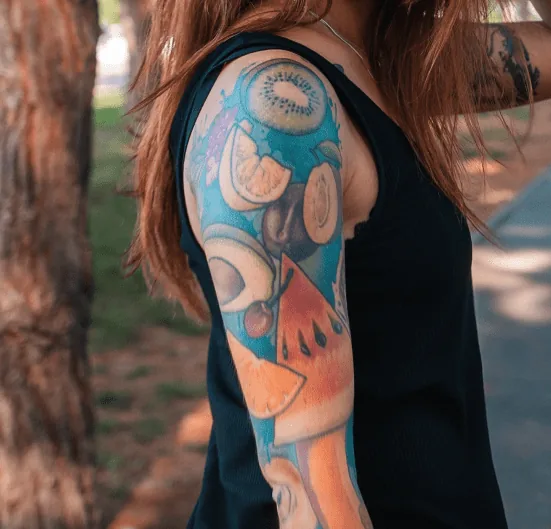
A tattoo that mixes black outlines, red roses, and green leaves isn't one removal problem — it's three, layered on top of each other. A thoughtful plan treats it as such. Over a course of sessions, the physician targets each color band with the wavelength that breaks it apart most effectively, often starting with the colors that respond fastest and giving the stubborn greens and blues the extra passes they need.
Because different colors clear at different rates, a multi-color tattoo often fades unevenly for a while — the black and blue may nearly disappear while a patch of green or yellow lingers. That's expected, not a failure, and it's why the total session count for a colorful piece tends to run longer than for solid black work of the same size. Your flat-rate package is built to cover that full course, whatever combination of colors your art contains.
Why a Physician — Not a Machine Preset — Sets Your Treatment
Everything in this guide comes down to matching: the right wavelength to each ink color, and the right energy to your skin tone. Get that matching wrong and you either waste sessions on ink that won't respond or risk pigment changes in the skin. Get it right and you get efficient fading with a strong safety margin. That judgment is medicine, not a menu button.
Laser Eraser is physician-led. Every treatment is performed by a licensed medical provider rather than delegated to a technician running a preset — a real difference from the franchise and spa clinics nearby. Our co-founder Dr. Alvaro Alban is an emergency-medicine physician in New Jersey who pursued specialized training at the Institute for Laser Medicine in Skippack, Pennsylvania, with a focus on tattoo removal including large and multi-color pieces, full back pieces, and arm and leg sleeves. When your skin tone and ink colors both factor into the settings, having a physician choose them is the safeguard that matters most.
Frequently asked questions
Yellow, white, and light blue-green shades are generally the hardest to remove because they poorly absorb the wavelengths lasers produce — and white can even oxidize and darken. Green and light blue are the classic stubborn colors, requiring a red-light wavelength and usually a few extra sessions. Black and dark blue, by contrast, are the easiest because they absorb nearly all wavelengths.
Yes. Color is one of the biggest factors in session count. An all-black tattoo may sit toward the lower end of the typical 8-to-12-session range, while a dense multi-color piece with greens, light blues, or yellows tends toward the higher end. With Laser Eraser's flat-rate complete package, though, every session your tattoo needs is included, so a harder color doesn't raise your price.
Yes. Darker skin (Fitzpatrick types IV–VI) is fully treatable — it just requires more conservative, melanin-sparing settings, typically a longer wavelength like 1064 nm and sessions spaced to let skin recover. Modern picosecond lasers like PicoWay spread far less heat than older devices, and a physician choosing the settings is the key safeguard against pigment changes.
Because a pigment looks green by reflecting green light and absorbing other colors. To break green ink apart, the laser must deliver a wavelength the pigment actually absorbs — red light, around 660–694 nm. A wavelength that removes black won't remove green efficiently, which is why a device with multiple wavelengths, like PicoWay, is important for colorful tattoos.
The Fitzpatrick scale classifies skin into six types based on how it responds to sun exposure, from very fair (Type I) to deeply pigmented (Type VI). It matters because melanin absorbs laser light too, so a physician uses your Fitzpatrick type to choose a safe wavelength, energy, and pace — protecting your skin from hyperpigmentation or hypopigmentation while still targeting the ink.
Yes. Multi-color tattoos are treated as several removal problems layered together, with each color band targeted by the wavelength that breaks it apart best. Colors fade at different rates, so a piece may look uneven for a while — that's expected. PicoWay's multiple wavelengths make this possible, and your flat-rate package covers the full course of sessions your colorful tattoo needs.