
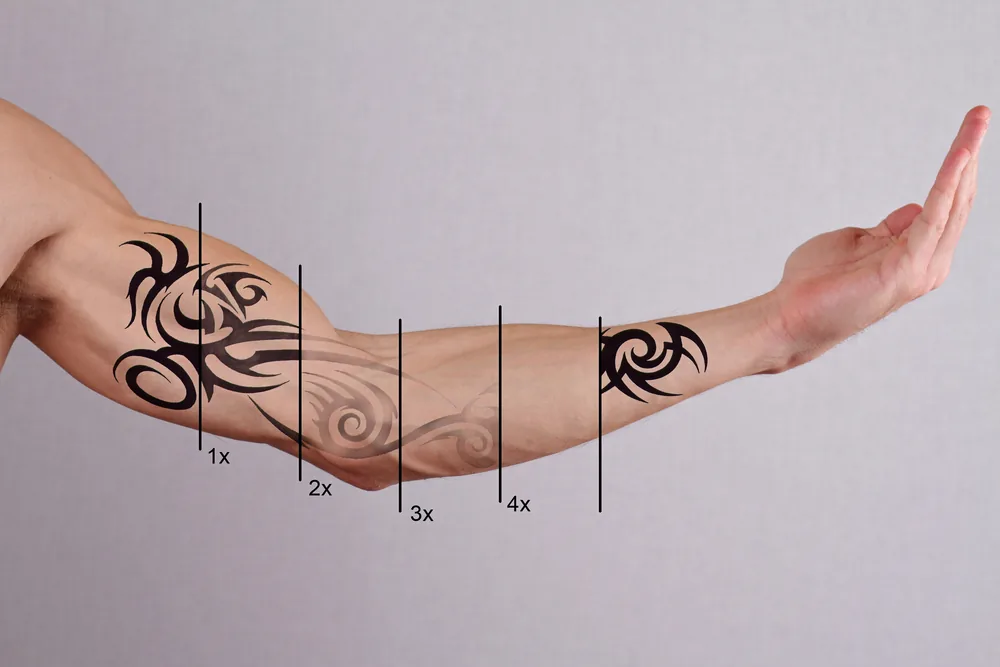
Tattoo removal has existed almost as long as tattooing itself. For centuries people abraded, cut, or burned ink from skin with painful, scarring results. The real breakthrough came in the 1960s with lasers, and today's picosecond technology like PicoWay removes ink safely by shattering it for the body to clear.
Why has tattoo removal always existed?
For as long as people have marked their skin, some have wanted those marks gone. Ancient cultures across Egypt, Polynesia, and Rome used tattoos to signal status, belief, or belonging, but circumstances change: allegiances shift, values evolve, and a mark that once meant one thing can come to mean another. The desire for a fresh start is not modern. It is one of the oldest human impulses, and it drove centuries of experimentation long before anyone understood the skin at a cellular level.
How did people remove tattoos before lasers?
Early methods were as painful as the tattooing itself and far more dangerous. Without an understanding of how ink sits in the skin, people simply tried to remove the skin. The results were unreliable, and scarring was common.
In ancient Rome, soldiers branded with marks of dishonor sometimes cut the tattooed skin away entirely, a testament to how heavy the social stigma could be. Progress across the following centuries was incremental and rarely gentle.
- Abrasion, scrubbing skin raw with salt or coarse tools to grind out pigment
- Excision, cutting the tattooed skin out with a blade
- Caustic chemicals, applying vinegar, limewater, or tannic acid to burn away the surface
- Herbal ointments in the Middle Ages, mild but largely ineffective
- Dermabrasion and cryosurgery in the 20th century, sanding or freezing the skin before removing layers
What changed in the 19th and 20th centuries?
The Industrial Revolution brought real interest in dermatology. Surgeons began excising tattoos under anesthesia, which was marginally safer but expensive and still scarred. Doctors experimented with acids like tannic acid that faded ink while corroding tissue. By the mid-1900s, dermabrasion and cryosurgery were popular but imprecise, and many patients traded a tattoo for a scar.
Throughout this era, removal was often reserved for those who could afford it and who felt pressure to fit conventional norms. The tools improved, but the fundamental problem remained: every method attacked the skin rather than the ink.
How did lasers change everything?
The turning point arrived in the 1960s, when researchers discovered that specific laser wavelengths could target tattoo pigment while sparing the surrounding skin. This principle, called selective photothermolysis, finally separated the ink from the tissue holding it. Early lasers were crude, but the idea was revolutionary and it defines every modern treatment.
Today we use Q-switched and, more importantly, picosecond lasers. At Laser Eraser, that means the PicoWay laser, which fires pulses measured in trillionths of a second. Instead of heating and burning ink, these ultra-short pulses shatter it into microscopic particles that your body's lymphatic system gradually clears away. Different wavelengths address different ink colors, so even large, multicolor pieces can be treated with precision.
What does modern removal actually involve?
Modern removal is a series of quick, well-tolerated sessions rather than a single dramatic procedure. Most tattoos need roughly 8 to 12 sessions to fully clear, spaced weeks apart to let the body process the fragmented ink between visits. How many you need depends on the tattoo's age, location, ink type, and your skin, which is why we assess each case individually at a free consultation.
Because removal is a medical treatment, who performs it matters. Laser Eraser is physician-led. Dr. Alvaro Alban, an emergency-medicine physician who pursued specialized training at the Institute for Laser Medicine in Skippack, Pennsylvania, oversees care personally, and every treatment is clinician-administered rather than delegated to a spa technician.
What does tattoo removal cost today?
Historically, cost put safe removal out of reach for most people. That has changed. At Laser Eraser we price by the finished result, not the visit: one flat-rate package covers every session your tattoo needs for complete removal, which saves roughly 38 percent compared with paying session by session.
Packages start priced individually, with no hidden fees. Because cosmetic removal is not covered by insurance, we make pricing transparent up front so you know your full cost before you begin.
Frequently asked questions
It is far gentler than the historical methods described here. Most patients compare the sensation to a rubber band snap, and sessions are typically quick. Many tell us it was less painful than they expected.
Most tattoos take roughly 8 to 12 sessions for complete removal, though the exact number depends on ink color and type, the tattoo's age, its location, and your skin. We give you an individualized estimate at your free consultation.
Yes. The PicoWay picosecond laser uses different wavelengths matched to different ink colors, which is why it can treat large, multicolor tattoos rather than only black ink.
Modern picosecond lasers target the ink while sparing surrounding tissue, which dramatically reduces the scarring risk that made older methods so problematic. At Laser Eraser every treatment is performed under physician oversight and customized to your skin type.