
The leg sleeve. It is a commitment. Unlike a small tattoo on the wrist or shoulder, a leg sleeve is a massive piece of art that wraps around the limb, often extending from the ankle to the thigh. It represents hours of needlework, significant expense, and for many, a major chapter of their life.
But chapters end. Tastes change. What was once a source of pride might now be a source of regret, professional hindrance, or simply an aesthetic that no longer fits who you are. If you are considering leg sleeve tattoo removal in Clark, NJ, you are facing a different challenge than someone removing a small name or symbol.
Removing a large-scale tattoo is a marathon, not a sprint. It requires a strategic approach, patience, and the right technology. At Laser Eraser, we specialize in large-volume ink removal. We understand the biology, the physics, and the psychological stamina required to clear a full sleeve.
In this detailed guide, we will break down exactly what it takes to remove a leg sleeve, why removing ink from the lower body presents unique challenges, and the realistic results you can expect from our clinic in Clark.
The Scope of the Project: Defining a “Leg Sleeve”
When we talk about leg sleeves, we are talking about a significant amount of surface area. This isn’t just one tattoo; it is often a collection of tattoos or a cohesive background that covers 30% to 50% of your body’s total skin surface on that limb.
Because of the sheer volume of ink, removing a leg sleeve is biologically taxing on the body. When a laser shatters ink particles, your lymphatic system (the body’s drainage system) has to process that debris. If we were to treat an entire leg sleeve in one sitting, it would overwhelm your immune system, potentially causing extreme swelling, sickness, or “tattoo flu.”
Therefore, the first thing to understand about removing a leg sleeve is that we treat it in sections. We might treat the lower leg (shin/calf) in one session, and the upper leg (thigh/hamstring) in another session 4 to 6 weeks later. This sectional approach ensures your safety and keeps the healing process manageable.
Why Legs Are Different: The Physics of Circulation
Location is the single biggest factor in tattoo removal speed, aside from the ink itself. This is where leg sleeves face a specific biological hurdle: gravity and circulation.
Your body relies on blood flow to carry white blood cells to the tattoo site to “eat” the shattered ink particles and carry them away.
- The Upper Body Advantage: Tattoos on the neck or chest have strong blood flow because they are close to the heart.
- The Lower Body Challenge: The further down the leg you go, the slower the circulation. The ankle and foot are the furthest points from your heart. Blood has to fight gravity to return up the leg.
This means that the ink on your thigh will likely fade faster than the ink on your shin or ankle. It is not uncommon for a leg sleeve to fade unevenly, with the upper sections clearing up months before the lower sections. Understanding this biological reality is key to managing your expectations.
How Long Does It Take? The Timeline
This is the question every client asks. “When will it be gone?”
For a standard, small tattoo, we often quote a range of 8 to 12 sessions. For a full leg sleeve, the timeline is often extended due to the need for sectional treatments and the slower healing rate of the lower extremities.
The Session Count
You should expect to need anywhere from 10 to 15+ sessions for complete removal of a dense leg sleeve. However, remember that because we treat in sections, “one pass” over the whole leg might actually take two or three appointments.
The Time Between Sessions
We typically space sessions 8 to 10 weeks apart for leg tattoos. Why so long? Because circulation is slower in the legs, the body needs more time to flush the ink. Treating too frequently doesn’t speed up the process; it just damages the skin because the ink hasn’t cleared yet.
The Total Duration
If you are treating the leg in halves (upper and lower), and waiting 8 weeks between treating the same area again, you are looking at a multi-year journey.
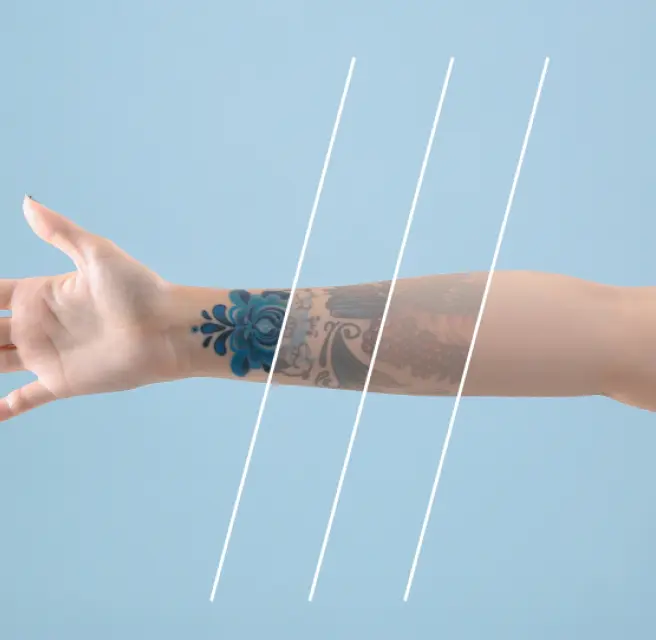
- Year 1: Significant fading. The tattoo will look broken up and lighter.
- Year 2: Clearance of shading and lighter lines. Stubborn linework remains.
- Year 3: Final clearance of deep, stubborn ink.
It is a commitment. But as many of our clients at Laser Eraser will tell you, the time passes anyway. You can spend the next two years with a tattoo you hate, or you can spend the next two years watching it disappear.
What Results Can You Expect?
Despite the challenges of circulation and size, leg sleeves can be removed successfully. The results depend heavily on the technology used and your adherence to aftercare.
Complete Removal vs. Fading for Cover-Up
- Complete Removal: This is the goal of returning the skin to its natural tone. It is achievable, but it takes the most time. You may have faint “ghosting” (hypopigmentation) where the ink used to be, especially if the tattoo was very dense.
- Fading for Cover-Up: Many of our leg sleeve clients aren’t looking for bare skin; they want to replace old work with new art. In this case, we only need to fade the tattoo by 50-70%. This might only take 5 to 8 sessions per section, significantly shortening the timeline.
To see real examples of large-scale removal, visit our Before & After gallery. You will see how dense blackwork breaks down over time, revealing the skin beneath.
The Laser Eraser Difference: Technology Matters
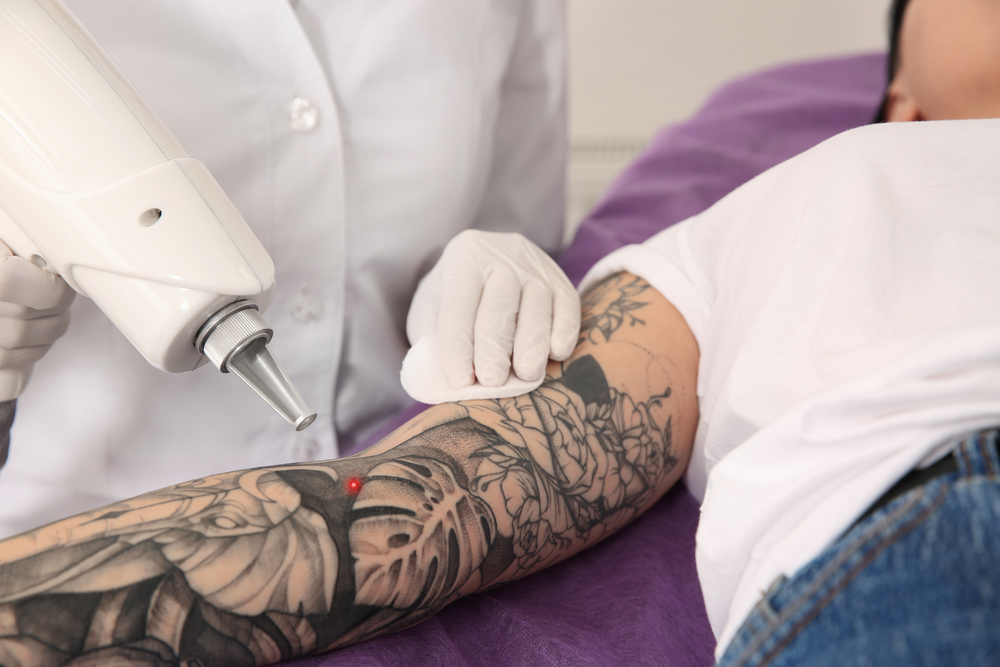
Removing a leg sleeve requires heavy artillery. You cannot tackle a project this size with an underpowered laser found at a local spa. You need medical-grade technology that can sustain high power over a large surface area without overheating or losing efficacy.
At Laser Eraser in Clark, NJ, we use the world’s most advanced laser systems. Here is why that matters for your leg sleeve:
1. Multi-Wavelength Capability
Leg sleeves are often colorful. Traditional Japanese sleeves might have wind bars (black), koi fish (orange/red), and water (blue).
- 1064nm: Targets black and dark ink.
- 532nm: Targets red and orange ink.
- Other wavelengths: Target blues and greens.
Our technology allows us to switch wavelengths instantly to target every color in your sleeve effectively.
2. Picosecond Speed
Older lasers used nanosecond pulses (billionths of a second). Our advanced technology uses picosecond pulses (trillionths of a second). This faster speed creates a “photo-acoustic” effect—it shatters the ink with sound waves rather than just heat.
- Why it helps legs: Less heat means less trauma to the skin. Since leg circulation is poor, minimizing trauma is crucial to preventing blisters and scarring.
3. Large Spot Sizes
Our lasers can maintain high energy even with a large spot size (the width of the laser beam). A larger spot size penetrates deeper into the dermis, reaching the deep ink found in the thick skin of the thigh and calf much more effectively than smaller lasers.
Pain Management for Large Areas
We won’t sugarcoat it: laser removal hurts. It feels like a rubber band snapping against the skin, over and over again. When you are treating a small wrist tattoo, it’s over in 30 seconds. When you are treating a half-leg sleeve, you might be in the chair for 20 to 30 minutes.
Managing comfort is a priority at Laser Eraser.
- Zimmer Cooling: We use a specialized machine that blows sub-zero air onto the skin before, during, and after the laser pulses. This numbs the area and significantly reduces pain.
- Breaks: Because we aren’t rushing, we can take breaks whenever you need them.
- Topical Numbing: We can advise on numbing creams you can apply before your appointment to take the edge off.
The Healing Process for Legs
Recovering from a leg treatment is different from recovering from an arm treatment. Because legs are dependent and subject to gravity, swelling is a major factor.
What to expect immediately after:
- Swelling: Your leg or ankle may swell significantly. This is normal fluid buildup caused by the inflammation of treatment.
- Blistering: Because the skin on the legs is often thicker and tighter, blistering is more common here than on the chest or back.
- Itching: As the immune system goes into overdrive, the area will itch intensely.
Critical Aftercare for Legs:
- Elevate: For the first 24-48 hours, keep your leg elevated above your heart as much as possible. This helps drain the fluid and reduce swelling.
- Compression: We often recommend wearing loose clothing, but sometimes a light compression sock (once blistering has subsided) can help with circulation.
- Movement: While you shouldn’t run a marathon the next day, gentle walking helps get the lymphatic system pumping. Avoid stagnation.
For a deeper dive into how the removal process works biologically, check out our Tattoo Removal page.
Cost Considerations for Leg Sleeves
As we discussed in our pricing guide, size is the biggest determinant of cost. A leg sleeve is a large investment.
However, because we treat in sections, the cost is spread out. You aren’t paying for the removal of the entire sleeve at every visit; you are paying for the section being treated.
- Example: If we treat the lower leg in January and the upper leg in February, you are splitting the cost of a “full pass” over two months.
We also offer unlimited packages. For a large project like a sleeve, an unlimited package is almost always the most financial sense. It caps your cost. Whether it takes 10 sessions or 20 sessions to clear that stubborn ankle ink, you never pay a penny more than the package price.
Ready to Start the Journey?
Removing a leg sleeve is a big decision. It requires time, money, and resilience. But the freedom of looking down and seeing clear skin—or a blank canvas for new art—is worth the effort.
At Laser Eraser, we are the experts in high-volume, complex tattoo removal in Union County. We don’t dabble in this; it is what we do. We have the protocols, the technology, and the experience to guide you through this long journey safely.
Don’t let the size of the tattoo scare you off. Every journey begins with a single step (and a single pulse).
If you are in Clark, Westfield, Cranford, or the surrounding areas, come see us. Let us look at your sleeve, break down a sectional treatment plan, and give you a realistic timeline.
Contact us today for your free consultation.
Visit LaserEraserNow.com/contact-us or call our office to get started.
Laser Tattoo Removal in Clark, NJ
Erase the Past with the PicoWay® Laser—Advanced Tattoo Removal Performed by Board-Certified, Physician-Owned & Operated Physicians.
Contact Us